Croatia already bought HIMARS from the United States.
By E.K KING
Now it is buying 18 K239 Chunmoo rocket launchers from South Korea.
For a country of fewer than four million people, that raises an obvious question: Why operate two systems that appear to do much of the same job?
The answer may tell us something bigger about where Europe’s arms market is heading.
Because the competition is no longer just about who makes the better weapon.
It is increasingly about who can actually deliver it when it is needed.
Croatia has approved the purchase of 18 K239 Chunmoo multiple-launch rocket systems in a deal worth about €544.1 million. The package includes launchers, ammunition and related equipment, with the program scheduled to run from 2026 to 2029.
The new systems will replace Croatia’s aging M-92 Vulkan and Soviet-designed BM-21 Grad rocket launchers.
On its own, that would look like a straightforward military modernization program.
Except Croatia had already made another choice.
It chose HIMARS.
In 2024, the United States approved the possible sale of eight M142 High Mobility Artillery Rocket Systems, or HIMARS, and related equipment to Croatia.
HIMARS has become one of the most recognizable Western weapons of the war in Ukraine. Its appeal is straightforward: move quickly, launch precision-guided rockets, and leave before the enemy can respond.
For a relatively small Croatian military, eight HIMARS already represented a major increase in long-range firepower.
Which leads to the more interesting question.
Why not simply buy more HIMARS?
Croatia went in a different direction.
It turned to South Korea – and ordered 18 Chunmoo launchers.
More importantly, the HIMARS are not going away.
Croatian Prime Minister Andrej Plenković has described HIMARS and Chunmoo as complementary systems.
That detail changes how this deal should be understood.
Croatia is not choosing a winner between an American and a Korean rocket launcher.
It is creating another option.
South Korea Is Selling More Than a Rocket Launcher
The K239 Chunmoo is often compared with HIMARS, but the two systems are not identical.
One important feature of Chunmoo is its two ammunition pods, allowing a launcher to carry different types of rockets depending on the mission.
That flexibility matters.
But comparing range, payload and launcher specifications alone misses what may be the most important part of Croatia’s decision.
Croatian Defense Minister Ivan Anušić pointed to several practical reasons behind the purchase: delivery time, availability, price and opportunities for industrial cooperation.
One of those stands out.
Delivery time.
The expected timeline is roughly 24 to 36 months.
In peacetime, waiting several years for a weapons system might not sound remarkable.
Europe is no longer operating under the assumptions of the old peacetime defense market.
Russia’s invasion of Ukraine pushed governments across the continent to rebuild stockpiles, increase defense spending and replace equipment at roughly the same time.
That created a problem that cannot be solved by comparing brochures.
A country can decide what weapon it wants.
But can the manufacturer build enough of them?
And how long will the customer have to wait?
A highly capable weapon that arrives years too late can become a very different proposition for a military trying to rebuild quickly.
This is where South Korea has found an opening.
It does not have to prove that every Korean weapon is superior to every American or European competitor.
It has to offer capable systems – and demonstrate that it can produce and deliver them at scale.
That strategy is already working.
Poland has made major purchases of Chunmoo. Estonia and Norway have also joined the list of European customers.
Now Croatia is joining them.
And there is another detail that deserves attention.
Croatia’s Chunmoo program will not be purely Korean.
Hanwha Aerospace will provide the launchers, ammunition and related equipment, while Poland’s WB Electronics will supply command-and-control technology.
That matters because it suggests something more permanent is taking shape.
South Korean defense companies are no longer simply shipping finished weapons from Asia to European customers.
They are increasingly becoming connected to a European industrial and supply network.
That could prove more consequential than the sale of 18 launchers itself.
So Is HIMARS Losing?
No.
And that distinction matters.
HIMARS still benefits from combat experience, the enormous U.S. military support structure behind it and widespread adoption among NATO members.
Croatia is not abandoning the system.
What is changing is the calculation behind weapons procurement.
For decades, comparisons between competing systems tended to revolve around familiar questions.
Which one has greater range?
Which one is more accurate?
Which one offers better performance?
The war in Ukraine has added another question:
What happens when everybody wants to buy at the same time?
And if a war lasts years rather than weeks, where does the next shipment of ammunition come from?
At that point, having another source of supply begins to carry strategic value of its own.
There is a cost to this approach.
Operating both HIMARS and Chunmoo means Croatia will have to manage different training, maintenance, ammunition and logistics requirements.
For a relatively small military, that added complexity is not trivial.
Croatia decided to do it anyway.
And that may be the most revealing part of the deal.
At first glance, this is a story about Croatia spending €544.1 million on 18 South Korean rocket launchers.
Look a little further ahead, and it becomes a story about something larger.
The European arms market has long been dominated by American and European defense companies.
South Korea is now pushing its way into that market.
And it is competing on more than weapon performance.
Production capacity matters.
Delivery time matters.
Ammunition supply matters.
And the willingness to bring European companies into the supply chain matters.
So the most important question raised by Croatia’s decision may not be:
Which is better, HIMARS or Chunmoo?
It may be:
When the next crisis arrives, who can still deliver on time?
That question could help decide where Europe’s next defense orders go.
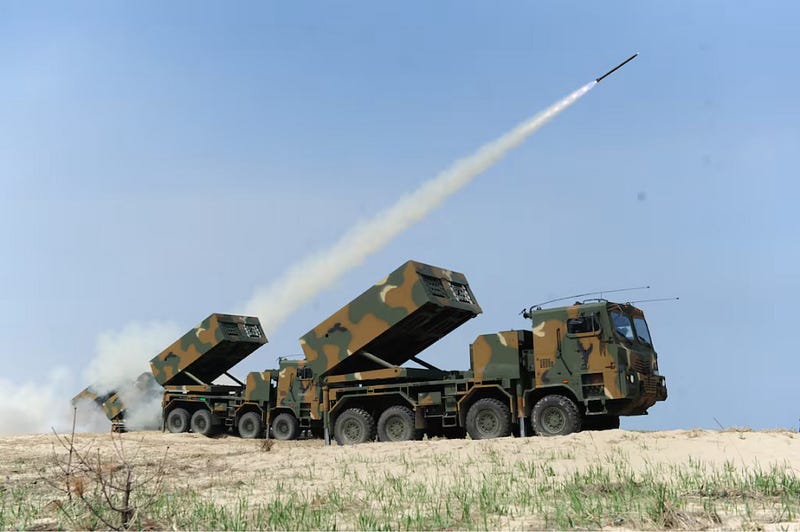
Courtesy of Hanwha Defense)
Originally published on Medium on September 7, 2026.
 Asia Horizon Review