Germany may not be looking for a better missile. It may be looking for more of them.
By E.K KING
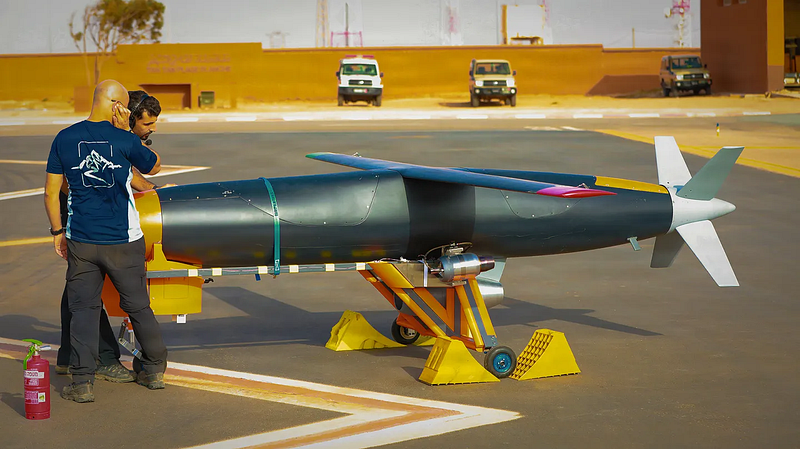
Imagine starting a company in 2024 and, just two years later, trying to convince one of Europe’s biggest military spenders to consider your cruise missile.
That would be ambitious even for an established defense contractor.
For a startup, it sounds almost absurd.
Cruise missiles are not products that normally go from a drawing board to a major military customer overnight. Their engines, guidance systems, warheads and launch systems must be tested repeatedly. Militaries also need to know whether they can survive electronic warfare, hit their targets reliably and integrate with existing command networks.
Yet that is exactly the market Covenant is trying to enter.
Founded in 2024, the U.S.-Israeli defense startup spent two years operating largely out of public view. Now Germany’s Defense Ministry has confirmed that talks are underway over Covenant’s Anthem cruise missile.
And there is an even more surprising part.
Germany has not publicly announced an Anthem purchase, but Covenant is already establishing production near Leipzig.
German-built Anthems are expected to begin production in the first quarter of 2027.
So why would a company only two years old believe it has a chance?
The answer may have less to do with building a better missile.
Europe is increasingly worried about whether it can build enough missiles at all.
Germany Has Money. That Doesn’t Mean Missiles Arrive Quickly.
Germany has been trying to strengthen its long-range strike capability as Europe prepares for the possibility of a prolonged confrontation with Russia.
It already has several paths forward.
The German military operates the air-launched Taurus cruise missile, but a newer version remains years away from fielding.
Berlin has also moved toward acquiring U.S. Tomahawk cruise missiles and the ground-based Typhon launcher. Tomahawks, with ranges exceeding 1,500 kilometers, could provide the kind of land-based deep-strike capability Germany currently lacks.
But there is a problem.
The United States needs missiles too.
Recent conflicts have placed additional pressure on American precision-weapon inventories and production capacity. Germany may be willing to spend more, but money alone cannot make a missile factory deliver faster.
Europe is also developing its own long-range strike options through ELSA, the European Long-Range Strike Approach. But that effort is still taking shape.
Germany’s problem, then, is not simply finding a capable missile.
Those already exist.
The harder questions are:
How quickly can you get them?
And:
How many can you get?
That is the opening Covenant is trying to exploit.
Covenant Isn’t Really Selling “The Best Missile”
Anthem’s most important selling point may not be a spectacular range figure or some revolutionary technology.
Covenant is making a much simpler pitch:
Make cruise missiles cheaper. Make them faster. Make a lot of them.
The company says Anthem is ready for production and that flight testing is taking place regularly.
Public information about the weapon remains limited. Anthem is reportedly ground-launched and uses a solid-fuel booster before transitioning to jet-powered cruise flight. It can carry a payload of more than 200 kilograms, while Covenant is developing variants for land and maritime targets.
But another number could prove more important to potential customers.
Price.
Covenant executives have reportedly set a mid-six-figure target price per missile once serial production is underway.
A current-generation Taurus missile costs at least around $1 million.
That does not mean Anthem is automatically a better deal.
Range, accuracy, electronic warfare resistance, survivability against air defenses, warhead performance and reliability all matter. Comparing two cruise missiles purely by price would tell us very little.
But the calculation starts to change when a military needs 1,000 missiles instead of 100.
At that point, price is no longer just a procurement issue.
It becomes part of war planning.
The Factory May Matter More Than the Price
Covenant is offering something else that could be even more attractive to Germany:
a production line in Europe.
The company’s main facility is located in Grand Prairie, Texas. Another plant is in Israel.
Its third manufacturing site is being established near Leipzig in eastern Germany, with German-built Anthems expected to enter production in the first quarter of 2027.
That matters because recent wars have exposed an uncomfortable weakness in Western military planning.
Buying an advanced weapon is one thing.
Replacing it during a long war is another.
A military can begin a conflict with a large stockpile and still run into trouble if missiles are being fired faster than factories can replace them.
And if the production line is on another continent, domestic spending alone cannot solve the problem.
Local production changes that calculation.
For Germany, a European Anthem production line could mean greater control over supply, shorter logistics chains and less dependence on overseas manufacturing capacity.
In other words, Covenant is not simply trying to sell Germany another cruise missile.
It is also selling the ability to keep making them.
There Is Still a Very Big “If”
There is an obvious problem with this story.
Covenant still has to prove it can deliver what it promises.
The company was founded only in 2024 and employs roughly 200 people.
It says Anthem is production-ready and that flight testing is taking place regularly. But getting a missile into the air is not the same as proving that it is a mature weapon capable of performing reliably under combat conditions.
Several important questions remain unanswered publicly.
How well does Anthem operate in a heavily jammed environment?
How accurate is it under realistic conditions?
How capable is it of surviving modern air defenses?
What is its effective operational range?
And how would it be integrated into Germany’s command-and-control and launch architecture?
Germany’s Defense Ministry has confirmed that discussions with Covenant are ongoing.
It has not announced a purchase.
There is no publicly announced quantity, contract value or deployment schedule.
That distinction matters.
Anthem should not yet be described as a replacement for Taurus or Tomahawk. There simply is not enough public evidence to make that judgment.
But the fact that Germany is willing to talk to Covenant is interesting on its own.
Why Is Germany Even Talking to a Two-Year-Old Company?
Recent wars have forced Western militaries to reconsider something they had spent decades taking for granted.
For years, the trend was toward increasingly sophisticated weapons: longer range, greater precision, better sensors and improved survivability.
All of those things still matter.
But a prolonged war introduces another number:
inventory.
A missile can be extraordinarily capable.
Once the stockpile is empty, its specifications no longer matter.
If a military can fire missiles faster than industry can replace them, what begins as a military problem eventually becomes an industrial one.
That is the bet behind Covenant.
The company has not demonstrated publicly that Anthem is superior to Taurus or Tomahawk. Nor is there enough evidence yet to conclude that it has reached the same level of maturity.
Instead, Covenant is proposing a different trade-off.
Perhaps every missile does not need to maximize every performance metric if it can be manufactured more cheaply, produced locally and replenished much faster.
That brings us back to the original question.
How does a two-year-old company dare to pitch cruise missiles to Germany?
Maybe it is not because Covenant has suddenly figured out how to beat the defense giants at their own game.
Maybe the game itself is changing.
Germany may no longer be asking only:
What is the best missile we can buy?
It may also be asking:
If a war lasts for years, how many will we still have left?
Originally published on Medium on September 13, 2026.
 Asia Horizon Review