By E.K KING
On September 8, Chinese state broadcaster CCTV released footage of another amphibious exercise involving the People’s Liberation Army’s 74th Group Army.
The report was brief. An amphibious armored unit from an unnamed brigade was conducting what CCTV described as a “sea-and-land live-fire assessment.”
No location was given. The size of the exercise was not disclosed, and the vehicles were not identified.
On its own, there was not much to work with.
But the 74th Group Army has appeared in similar reports before, and once those records are put together, the latest exercise becomes more interesting.
One location keeps coming up: the waters off eastern Guangdong.
In May 2022, Chinese military media reported that an armored unit from a combined-arms brigade under the 74th Group Army conducted live-fire training at sea in eastern Guangdong.
Around the same period, more than 100 newly trained drivers from the brigade went through their first assessment operating amphibious armored vehicles at sea.
Go back another two years and the pattern is still there.
In July 2020, the “Hard-Boned Sixth Company” of a brigade under the 74th Group Army trained in waters off eastern Guangdong. More than a dozen amphibious armored vehicles entered the sea, formed up offshore and advanced toward a landing area.
A similar exercise was reported in 2019. Dozens of vehicles assembled along the shoreline before conducting offensive training under difficult sea conditions.
Again, Chinese military media gave the location as eastern Guangdong.
That does not prove the September 8 exercise took place there. CCTV did not disclose the location this time, and previous exercises cannot tell us where a vehicle was operating years later.
What they do show is that eastern Guangdong has repeatedly been used by amphibious forces of the 74th Group Army.
That gives us somewhere to start looking.
Then there is the question of the vehicles
CCTV described an “amphibious armored unit” but did not identify the equipment.
The 74th Group Army is known to operate amphibious assault vehicles and infantry fighting vehicles. Previous analysis of Chinese military footage has also identified equipment based on the Type 05 amphibious armored vehicle family serving with the force.
Type 05 is actually a family of vehicles.
It includes the ZTD-05 amphibious assault vehicle, the ZBD-05 amphibious infantry fighting vehicle and several vehicles built for reconnaissance, command and support roles.
The names are less important than what these vehicles are expected to do.
They are designed to leave land, travel across open water, approach a landing area and then continue operating ashore.
Chinese military media says Type 05 vehicles can travel at around 25 km/h on water, unusually fast for a tracked armored vehicle.
That helps explain why a “sea-and-land” assessment matters.
Crews are not simply learning how to keep a vehicle afloat. They have to navigate in waves, maintain formation, fire at sea, reach the coast and then make the transition back to fighting on land.
Last year offered a glimpse of how that training is built.
In March 2025, CCTV followed drivers from a brigade of the 74th Group Army as they went through an amphibious armored vehicle driving assessment.
They negotiated narrow S-shaped passages, embankments and other obstacles. One test required them to close their observation windows and drive at 20 kilometers per hour through a passage only 20 centimeters wider than the vehicle.
An officer interviewed at the time said the unit would next move on to maritime driving and live-fire training at sea.
A few months later, Chinese military media published photographs of amphibious armored vehicles from the 74th Group Army practicing formations on the water.
Now CCTV is reporting a sea-and-land live-fire assessment.
Put those reports together and the progression is easier to see:
land driving, entering the water, formation maneuvers, firing at sea, approaching the coast and continuing the mission ashore.
Each is a separate skill. Eventually they have to work together.
Something else has been happening this summer
The September 8 report also comes during a period of visible amphibious training elsewhere in the PLA.
On September 4, just four days before CCTV released the 74th Group Army footage, China Military Online published photographs showing Type 05 amphibious armored vehicles loading onto and leaving a Type 072A landing ship.
The photographs were taken during training in early August.
This is an important distinction: Chinese military media identified the vehicles only as belonging to an Army brigade. It did not identify that brigade as part of the 74th Group Army.
So there is no evidence that the two events were part of the same exercise.
But the photographs are useful for another reason.
They show what happens before and after the dramatic footage of armored vehicles racing through the water.
The vehicles have to get onto ships.
The Army has to work with the Navy.
They have to leave those ships at sea and form up before moving toward the coast.
And the 74th Group Army has not been the only formation doing this recently.
In another exercise in early August, an amphibious unit from the 72nd Group Army conducted maritime live-fire training, with amphibious infantry fighting vehicles firing while moving toward a beachhead.
These events cannot simply be combined into one exercise.
They do, however, show that amphibious training has been visible across more than one PLA Army formation in recent weeks.
Getting a vehicle onto the beach is only the beginning
This is where counting amphibious vehicles becomes less useful.
Even if an armored unit reaches shore successfully, more troops still have to arrive. Fuel and ammunition have to follow. Engineers may need to clear obstacles, while units offshore have to remain connected with those already moving inland.
Past exercises involving the 74th Group Army have included more than armored vehicles.
During training off eastern Guangdong in 2018, amphibious infantry fighting vehicles and assault vehicles operated with landing ships, aircraft, drones, engineers and fire-support units.
A 2020 exercise brought together elements from the Army, Navy, Air Force and the PLA’s logistics system.
That tells us more about amphibious warfare than the specifications of any single vehicle.
The difficult part is making all of those pieces work at the same time.
Does this mean Taiwan?
It is the obvious question whenever PLA amphibious armor appears at sea.
There is currently no public evidence that the September 8 assessment was specifically directed at Taiwan. Nor does one training event show that a particular military operation is being prepared.
The longer timeline is more useful.
The 74th Group Army was conducting amphibious training off eastern Guangdong in 2019.
It was there again in 2020.
Its amphibious units were conducting maritime driving and live-fire assessments in 2022.
Training continued in 2025.
Now another sea-and-land live-fire assessment has appeared in 2026.
And this summer, other PLA formations have also been publicly training the less visible parts of amphibious operations – including moving Type 05 vehicles on and off Navy landing ships and conducting live fire while approaching a beach.
None of these events is remarkable enough to tell us that a conflict is approaching.
But together they make it easier to see what the PLA is spending time practicing.
For the 74th Group Army, the task has remained remarkably consistent: moving an armored force from land into the sea, across the water and back onto land while retaining the ability to fight.
We still do not know where the September 8 exercise took place.
We also cannot yet say with confidence which Type 05 variants appeared in the footage.
Those details will require better imagery.
For now, CCTV has given us only a few lines.
The rest of the picture is scattered across years of Chinese military reporting – and increasingly, across what other PLA amphibious units have been doing at the same time.
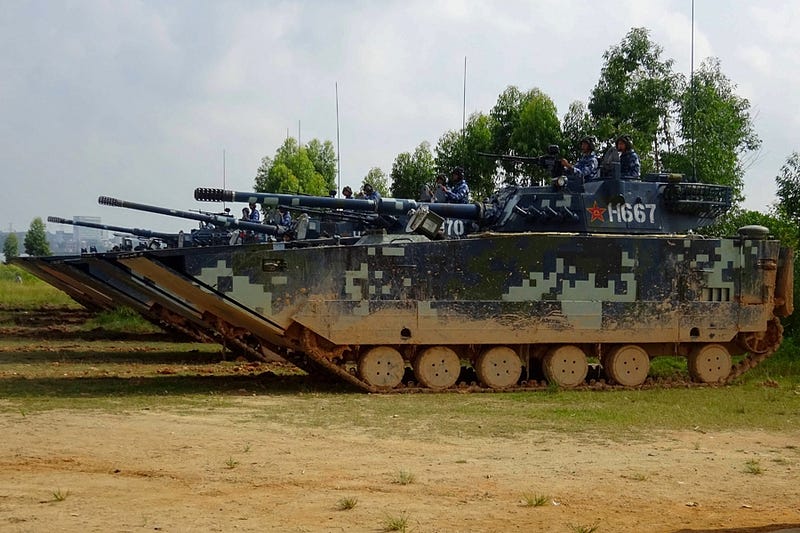
A Chinese ZTD-05 amphibious assault vehicle during the Joint Sea 2016 exercise. Photo: Mil.ru / Wikimedia Commons, CC BY 4.0.
Originally published on Medium on September 8, 2026.
 Asia Horizon Review