Task Force Falcon Strike will bring U.S. and Middle Eastern forces together to operate one-way attack drones across the air and sea.
By E.K KING
The U.S. military is building a new drone force in the Middle East that will be able to attack from the air, across the sea and from underwater.
U.S. Central Command announced Task Force Falcon Strike on Thursday, calling it its first attack-drone unit of this kind to include forces from several countries.
The idea is fairly simple. American personnel and military partners in the Middle East will work together with different types of unmanned weapons.
Some will fly. Some will travel across the water. Others will operate below the surface.
Many will be one-way attack drones – unmanned vehicles that carry explosives toward a target and are destroyed during the attack.
CENTCOM, which oversees U.S. military operations across much of the Middle East, has started inviting regional countries to join the new unit. It has not said which countries are taking part.
The new force comes only nine months after CENTCOM created another drone unit, Task Force Scorpion Strike, in December 2025.
That unit quickly went from testing drones to using them in combat.
In December, Scorpion Strike carried out the first launch of an aerial attack drone from a U.S. Navy warship.
A few months later, its one-way attack drones were used in Operation Epic Fury, the U.S. military campaign against Iran.
CENTCOM’s own April fact sheet lists LUCAS one-way attack drones among the weapons used in the operation, alongside U.S. bombers, fighter aircraft and missiles.
Scorpion Strike later took the idea to sea.
CENTCOM says unmanned attack boats were used against Iranian port facilities in July.
Falcon Strike is the next step. The U.S. now wants to bring these different types of drones together and operate them with other countries.
“Task Force Falcon Strike will expand on Scorpion Strike’s success given the tremendous innovation happening among our regional allies and partners,” CENTCOM commander Adm. Brad Cooper said.
Personnel from U.S. Special Operations Command Central will lead the new task force, with American and regional representatives working on its staff.
For now, there is still a lot CENTCOM has not revealed.
It has not named the countries joining Falcon Strike. It has not said how many drones the unit will have or when it will be ready.
There is also very little information about the underwater attack drones.
That is one of the more interesting parts of the announcement. Small aerial attack drones have become common in recent wars, and unmanned boats have also been used in combat. An underwater vehicle carrying explosives could approach ships or other targets while staying below the surface.
CENTCOM has not said what type of underwater system Falcon Strike will use, so its actual role remains unknown.
Why is the U.S. interested in cheaper attack drones?
The announcement comes during the U.S. war with Iran, which has put pressure on American weapons supplies.
Modern missiles are powerful, but many are expensive and take time to build. During a long conflict, thousands of weapons can be fired much faster than factories can replace them.
That creates a problem even for a military with a large defense budget.
One-way drones can be much simpler. If a cheaper drone can destroy a target, commanders may not need to use a more expensive missile for the same job.
They still have limits. A small drone cannot destroy every type of target, and some missions will continue to require larger missiles, aircraft or other weapons.
But recent wars have shown what can happen when these drones are used in large numbers.
Iran has used them. Russia and Ukraine have used them extensively. The United States is now putting more of its own attack drones into combat.
Scorpion Strike shows how quickly this can happen.
The unit was created in December. By the following year, its drones were being used against Iran.
Falcon Strike adds another test: whether several countries can operate these weapons together.
That could be difficult.
A Saudi drone, for example, may use different software or communications equipment from an American system. Military officers from different countries also need to know who controls each weapon and who can order an attack.
CENTCOM has not explained how Falcon Strike will handle those issues, and it has not said whether participating countries will bring their own drones.
Those details will become clearer if more countries publicly join the unit.
The experiment is also worth watching from Asia, although there is no announced plan to create a Falcon Strike-style unit in the Indo-Pacific.
The United States already works closely with countries such as Japan, Australia and the Philippines, and the Pacific has an obvious feature in common with the Middle East: military forces may have to operate across large areas of ocean.
For now, however, Falcon Strike is a Middle East project.
Its first real test will be much closer to Iran.
CENTCOM has already shown with Scorpion Strike that it can take a new attack drone from a Navy ship into combat within months.
Now it wants to see whether its regional partners can do it with them.
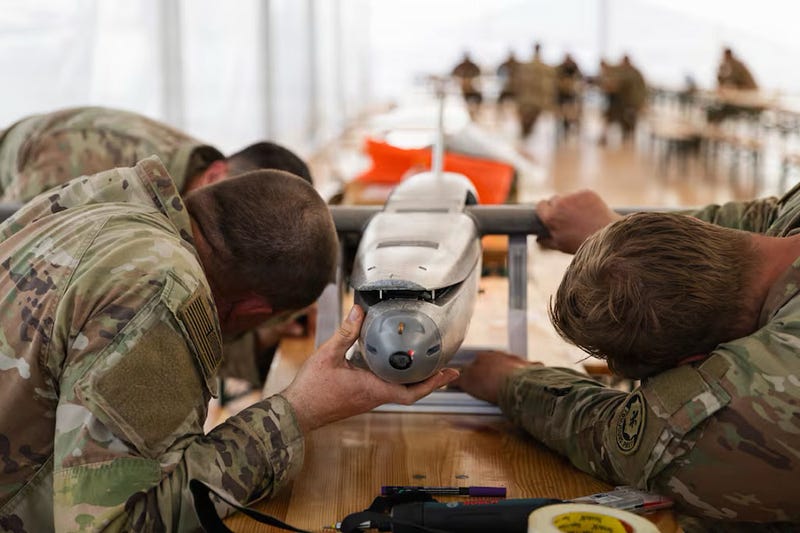
(Katherine Bustos/U.S. Army)
Originally published on Medium on August 17, 2026.
 Asia Horizon Review