For nearly a century, U.S. aircraft carriers have relied on pilots and manned aircraft.
By E.K KING
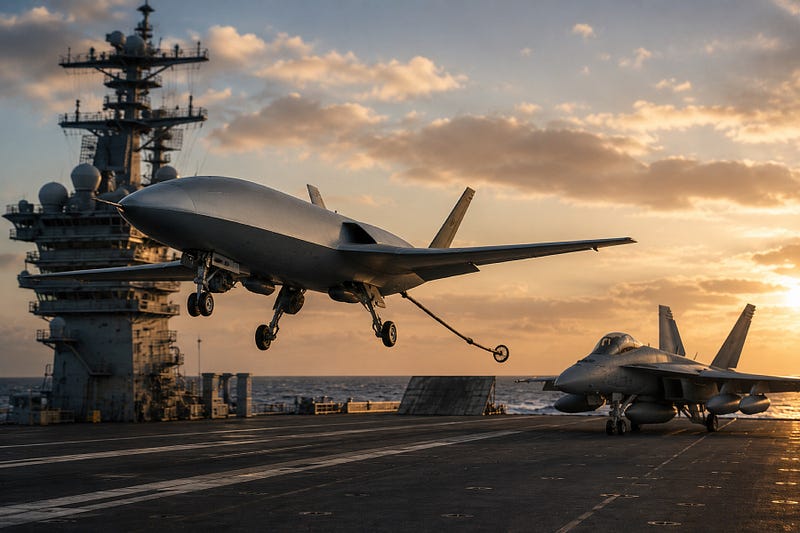
Now, drones are starting to join the team.
The USS Theodore Roosevelt has become the first U.S. Navy aircraft carrier fully ready to operate the MQ-25A Stingray, an unmanned aircraft built by Boeing.
And the first drone opening this new chapter isn’t a robot fighter.
It’s basically a flying gas station.
That may sound less exciting than an unmanned fighter jet. But the MQ-25 could change how American aircraft carriers operate – especially across the vast distances of the Indo-Pacific.
Why does the Navy need a flying gas station?
Aircraft carriers are designed to bring air power almost anywhere in the world.
But fighter jets have one obvious limitation: fuel.
Today, the Navy sometimes uses F/A-18 Super Hornets to refuel other aircraft in the air. A Super Hornet carries extra fuel, meets another aircraft and transfers that fuel while both are flying.
It works.
But there is a cost.
A fighter being used as a tanker isn’t available for other missions.
The MQ-25 is designed to take over some of that work.
Instead of putting a pilot and a fighter jet in the air simply to deliver fuel, the Navy can send an unmanned aircraft.
That could free more Super Hornets for missions they were originally designed to perform.
It could also help carrier aircraft fly farther from their ships.
The bigger change is happening on the carrier
The MQ-25 has been under development for years, so another test flight alone wouldn’t be particularly surprising.
What makes the latest development interesting is the USS Theodore Roosevelt itself.
According to a Pentagon acquisition report, the carrier’s Unmanned Air Warfare Center became fully operational and deployable in March 2026.
In simple terms, the Navy has now installed the equipment and systems aboard the carrier needed to control and support the MQ-25 during real deployments.
The USS George H.W. Bush was the first carrier to receive and test this infrastructure in 2024.
Now Theodore Roosevelt has moved beyond testing.
Another carrier is following.
USS Ronald Reagan is expected to have its own operational and deployable MQ-25 capability by the end of August 2026.
That means the Navy isn’t simply experimenting with a drone anymore.
It is preparing aircraft carriers to use unmanned aircraft as part of normal operations.
Why this matters in the Indo-Pacific
Look at a map of the Pacific and the problem becomes easy to understand.
The distances are enormous.
A carrier may want to remain farther away from dangerous areas while its aircraft still need to reach targets or patrol areas hundreds of kilometers away.
Fuel therefore becomes extremely important.
An unmanned tanker can help extend the distance carrier aircraft can operate without using another fighter for the refueling job.
This could become increasingly useful as anti-ship missiles make operating large aircraft carriers close to an enemy more dangerous.
For countries across the Indo-Pacific, the development is worth watching for another reason.
The MQ-25 may only be the beginning.
What comes after the tanker?
The first MQ-25 test aircraft flew years ago, and the program has faced delays along the way.
But it recently reached an important stage.
In May 2026, the program received approval to move from development toward production and deployment.
Boeing originally received an $805 million development contract from the Navy in 2018 for the design, development and testing of four aircraft. Earlier Navy plans envisioned eventually acquiring around 72 MQ-25s.
Those numbers matter.
But the more interesting question is what happens after the Navy learns how to routinely operate unmanned aircraft from carriers.
Future drones could perform very different missions.
Some could conduct surveillance. Others might carry sensors, electronic warfare equipment or weapons. Eventually, manned fighters and unmanned aircraft could routinely operate together from the same carrier.
Before that can happen, however, the Navy needs experience launching, controlling, maintaining and recovering unmanned aircraft at sea.
MQ-25 provides a way to start building that experience while also solving a practical problem today.
That may be its most important role.
The drone era aboard U.S. aircraft carriers may not begin with an autonomous fighter flying into battle.
It may begin with something much simpler:
A flying gas station.
And the USS Theodore Roosevelt is now ready for it.
What do you think comes next after the MQ-25 – surveillance drones, electronic warfare aircraft, or unmanned fighters?
Originally published on Medium on August 11, 2026.
 Asia Horizon Review