By E.K KING
A computer weighing about 20 pounds can now carry a 64-core processor, 1TB of memory, as much as 240TB of storage and a powerful GPU designed to run artificial intelligence and other demanding software close to the battlefield.
That gives a sense of how far military edge computing has come.
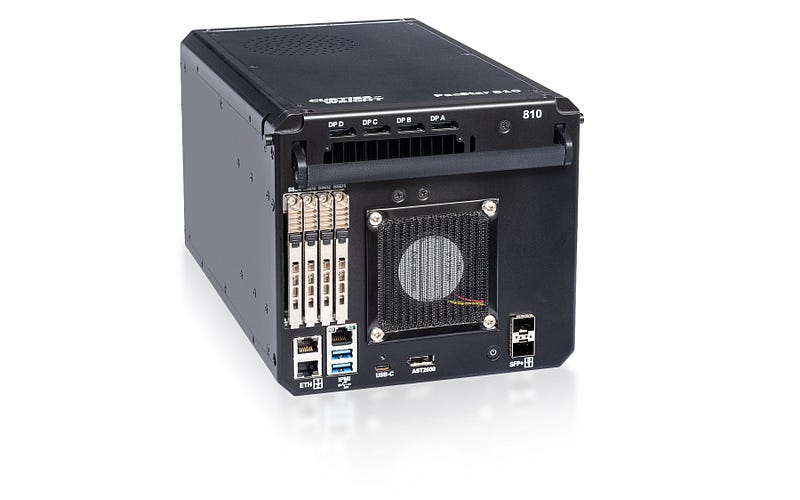
Curtiss-Wright unveiled the PacStar 810 on Tuesday, a rugged server designed for troops, mobile command posts and vehicles operating far from traditional data centers.
The specifications are striking for something weighing about 20 pounds, or 9.1 kilograms. According to the company, the system uses a 64-core AMD EPYC processor, up to 1TB of DDR5 memory and removable NVMe storage with capacity up to 240TB. It can also carry a GPU with 96GB of memory.
The important part is not simply that another defense company has released a new computer.
It is where this level of computing power is going.
Bringing the Data Center Closer to the Front
Modern military units collect enormous amounts of information.
Drones send back video. Radars track objects. Electronic warfare systems detect signals. Vehicles, satellites and other sensors add even more data.
Sending all of that information to a distant data center or cloud service for processing is not always practical.
A military network can have limited bandwidth. Connections can also be disrupted, jammed or lost. Units operating across islands, mountains or large stretches of territory may not always have a reliable link to a major computing center.
Edge computing moves some of that processing closer to where the information is collected.
Instead of sending everything hundreds or thousands of kilometers away, troops can process more data locally.
With enough computing power, an edge server could support tasks such as analyzing information from several sensors, running AI models, processing communications data or helping operators work with large amounts of drone imagery.
Curtiss-Wright says the PacStar 810 was designed for applications ranging from signal processing to coordinating or countering groups of unmanned aircraft.
Those are company claims, and the system’s real-world performance will ultimately depend on how it is configured and used. But its hardware illustrates how much computing power can now be packed into equipment designed to operate outside a conventional data center.
The U.S. Army Is Already Moving in This Direction
The timing also fits a much larger change inside the U.S. military.
The Army is developing Next Generation Command and Control, or NGC2, an effort to connect communications, applications, data and computing infrastructure so commanders can receive and use battlefield information more quickly.
NGC2 has moved beyond small laboratory demonstrations.
In June, the Army said the 4th Infantry Division had tested NGC2 at division scale after less than a year of development. Later that month, the Army established a common data layer for the system following operational testing with both the 4th and 25th Infantry Divisions. (美國陸軍)
During Project Convergence Capstone 6 in July, soldiers tested NGC2 alongside more than 90 developing capabilities. The Army specifically identified edge computing, third-party applications and AI models among the technologies being integrated into the system. (美國陸軍)
The scale of the planned investment shows that these systems are becoming more than experiments.
Army budget documents for fiscal 2027 request about $1.09 billion for C2 Compute Infrastructure. The documents say that funding would include 900 Tactical Edge Compute servers for NGC2 across three divisions, plus another 1,143 servers for other command-and-control requirements. (陸軍財務管理部)
Curtiss-Wright describes the PacStar 810 as suitable for NGC2, but that should not be confused with an Army selection of the product. The available information does not establish that the Army has chosen the PacStar 810 for those server purchases.
What matters is that the Army’s requirements and the development of systems like this are moving in the same direction: more computing power is being pushed closer to soldiers.
The Marines Want AI at the Edge Too
The U.S. Marine Corps is pursuing a similar idea through Project Dynamis.
The program is intended to improve how Marines collect, process and share information while operating in dispersed locations. One of its goals is to develop computing nodes at the tactical edge and use AI to help process battlefield information. (海軍陸戰隊)
Project Dynamis has already moved into repeated field experimentation. During exercises in early 2026, Marines worked with Army units and industry engineers to test new command-and-control capabilities and AI-enabled battle management systems. (海軍陸戰隊通信訓練支援中心)
Curtiss-Wright also lists Project Dynamis as a possible application for the PacStar 810. Again, that does not mean the Marine Corps has selected the server.
The broader connection is more interesting than the individual product.
Both services are trying to solve the same basic problem: modern forces are collecting more data than ever, while the places where that data is needed may have unreliable communications.
AI Changes the Hardware Needed at the Front
For years, a laptop or relatively small tactical server could handle many command-post computing jobs.
AI changes that equation.
Running larger AI models, analyzing multiple video feeds or combining information from several sensors can require much more memory and processing power.
That helps explain why equipment designed for the tactical edge is beginning to resemble a small data center.
There are still limits.
A rugged 9-kilogram server needs electricity. Powerful processors and GPUs generate heat. A unit must also move batteries, networking equipment and other hardware needed to keep the system operating.
And more computing power does not automatically produce better battlefield decisions. AI systems depend on good data, reliable software and communications, while human operators still have to understand and act on the information they receive.
But the direction is becoming clearer.
The military edge is no longer simply a place where soldiers collect information and send it somewhere else for analysis.
Increasingly, it is becoming a place where that analysis can happen.
A 20-pound server packed with hardware once associated with much larger computing systems is one small example of that shift.
The bigger story is that the distance between the battlefield and the data center is beginning to shrink.
Originally published on Medium on August 18, 2026.
 Asia Horizon Review