By E.K KING
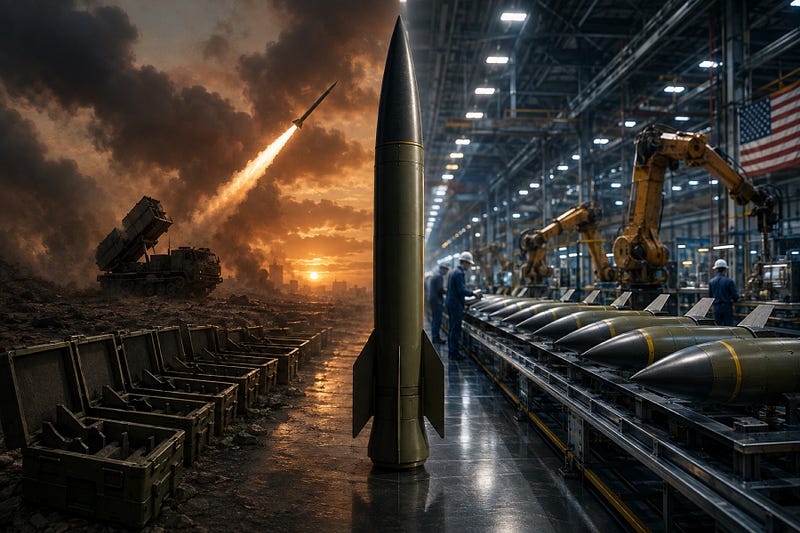
Five months of war with Iran have exposed a problem that even the world’s largest defense budget cannot quickly solve: missiles can be fired in minutes, but replacing them can take years.
Germany’s Rheinmetall is preparing to help Lockheed Martin produce ATACMS missiles in Europe, potentially creating an important new source of supply for the United States and its allies.
But Rheinmetall CEO Armin Papperger has delivered an uncomfortable warning.
Rebuilding depleted American missile inventories will take time – much more than two years.
That gap between wartime consumption and industrial production may prove more important than the number of missiles sitting in warehouses today.
Iran has become a stress test for the U.S. arsenal
According to Reuters, the U.S. Army consumed much of its global inventory of long-range precision missiles during the five-month conflict with Iran.
The pressure has been particularly serious for two Army weapons: the Army Tactical Missile System, better known as ATACMS, and the newer Precision Strike Missile (PrSM).
Reuters reported that sources familiar with U.S. inventory data described the available stocks of these weapons as having been heavily depleted.
These missiles matter because they allow forces to strike important targets from long distances without sending pilots directly into heavily defended airspace.
That makes the inventory problem larger than a simple question of how many missiles remain.
Every missile consumed in one theater is a missile that may not immediately be available for another crisis.
Germany is becoming part of the solution
Lockheed Martin and Rheinmetall signed a memorandum of understanding in July to establish ATACMS production in Germany.
The planned facility at Rheinmetall’s Unterlüß complex would become the first ATACMS production site outside the United States.
The project has the support of the U.S. and German governments and is intended to supply NATO and allied forces.
Production infrastructure is expected to begin taking shape in 2027, while Rheinmetall expects the joint venture to begin generating revenue in 2028.
For Europe, this is an important industrial shift.
For decades, European security has depended heavily on American weapons and American production capacity. Producing a major U.S.-designed precision missile in Germany begins to distribute that industrial burden across the Atlantic.
But a second factory does not instantly solve the shortage.
Papperger told Reuters that sufficient capacity should eventually be available to help replenish U.S. arsenals depleted during the Iran conflict.
His warning was equally clear: restoring those inventories will take considerably longer than two years.
The factory may matter as much as the missile
Modern military discussions often focus on the most visible hardware: aircraft, warships, drones and missiles.
A prolonged conflict forces a different question:
How quickly can you replace what you fire?
A military can enter a conflict with thousands of sophisticated weapons and still face trouble if it consumes them far faster than factories can replace them.
Production lines need specialized machinery, trained workers, explosives, rocket motors, guidance electronics and reliable suppliers. Expanding capacity can require new buildings, regulatory approvals and years of investment.
The Iran conflict therefore offers a warning extending far beyond the Middle East.
Industrial capacity is becoming part of military readiness.
And that brings the story to Asia
For Asian countries, especially those watching tensions across the Taiwan Strait and the wider Indo-Pacific, the lesson deserves attention.
The United States does not plan for only one theater.
Washington must consider commitments and potential crises involving Europe, the Middle East and the Indo-Pacific at the same time.
Long-range precision weapons would be especially important in a Pacific conflict, where enormous distances make stand-off weapons valuable.
If another prolonged conflict consumes U.S. missile inventories faster than industry can replenish them, American commanders could eventually face uncomfortable choices about where limited weapons should be deployed.
That does not mean the United States is suddenly unable to defend its interests. The Pentagon maintains enormous military capabilities, while American and European defense companies are already expanding production.
But Rheinmetall’s warning highlights a limitation that military budgets cannot immediately erase.
Congress can approve more money in months.
Factories take years.
Europe’s defense boom is becoming an industrial transformation
Rheinmetall has emerged as one of the largest beneficiaries of Europe’s rearmament.
Its Unterlüß complex is already expanding ammunition production, while a rocket-motor factory is nearing completion. Rheinmetall says production of rocket motors and guided-missile components there could begin in 2027.
ATACMS is another step in that transformation.
Papperger believes global demand could support an ATACMS market for another 15 years.
Rheinmetall is also pursuing other enormous European defense programs. The company expects a German Boxer armored vehicle contract to be signed before the end of 2026. Rheinmetall’s portion could be worth €12.4 billion, while the overall program involving KNDS could reach roughly €25 billion.
War is reshaping Europe’s industrial economy.
The uncomfortable lesson
There is an irony behind the current defense boom.
Every new missile factory can strengthen deterrence by convincing potential adversaries that NATO and its partners can sustain a prolonged conflict.
Yet the need for those factories also demonstrates how quickly modern warfare can consume weapons that took years to manufacture and stockpile.
The Iran war has provided another reminder that military power cannot be measured only by what a country owns on the first day of a conflict.
What matters is what remains on day 100 – and what factories can deliver on day 500.
For the Indo-Pacific, that may be one of the most important lessons to emerge from a war thousands of kilometers away.
⸻
Originally published on Medium on August 10, 2026.
 Asia Horizon Review