By E.K KING
Boeing’s new Ultra Low-Cost Seeker could bring radar guidance to more missiles and bombs – at a time when militaries are learning that sophisticated weapons are useless if they cannot afford enough of them.
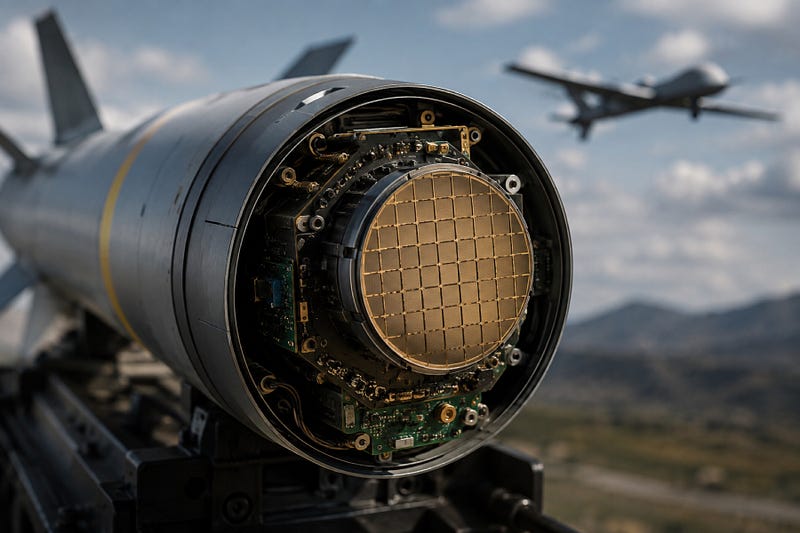
A missile can cost hundreds of thousands or even millions of dollars.
Part of that cost comes from something most people never see: a small sensor sitting inside its nose.
It is called a seeker.
Think of it as the missile’s eyes. It helps the weapon find and track its target during the final part of its flight.
Now Boeing wants to make those eyes much cheaper.
At the Space and Missile Defense Symposium in Huntsville, Alabama, Boeing unveiled its Ultra Low-Cost Seeker, or ULCS, a new active radar seeker designed around a simple idea: radar guidance should not have to be reserved for the most expensive weapons.
If Boeing can make that work, the bigger story may have less to do with one new sensor and more to do with how future wars are supplied.
Giving a missile its own radar
ULCS is an active radar seeker.
Instead of depending entirely on another aircraft or ground radar to illuminate a target, the seeker sends out its own radar signal and listens for the reflection.
That allows the weapon to locate and track a target as it approaches.
Boeing says ULCS is being designed to work against moving targets in all weather and could eventually be used on weapons launched from the air, land or sea.
But the interesting part is how Boeing wants to build it.
The company is using commercial components adapted for military use, rather than designing every part from scratch.
And it wants the same basic seeker architecture to work across several weapons.
One sensor, many weapons
Boeing is studying ULCS for three very different jobs: air and missile defense interceptors, guided bombs and cruise missiles.
Normally, different weapons may require their own sensors and engineering work.
Boeing wants ULCS to function more like a common platform.
The seeker uses a modular design and open standards, allowing engineers to modify it for different weapons without starting over each time.
The idea is similar to what happens in the automobile industry.
Several cars can look completely different while sharing engines, electronics or platforms underneath.
Producing common components at larger scale can bring costs down.
For missile production, that could matter enormously.
Boeing has already fired it
ULCS is still under development, but Boeing has moved beyond computer simulations.
The company conducted several tests earlier this summer.
Engineers first tested the sensor inside an anechoic chamber designed to prevent unwanted signal reflections.
Then they put it aboard a Beechcraft 1900 aircraft and flew it over land and water. Boeing said the seeker successfully detected and tracked targets.
A more demanding test followed at Spaceport America in New Mexico.
ULCS first tracked a passing drone while sitting on the ground.
Then Boeing mounted the seeker on a rocket acting as a missile and launched it toward another drone carrying a radar reflector that simulated a larger target.
The seeker had to survive the acceleration and vibration of launch while continuing to operate.
According to Boeing, it detected and tracked its targets during every test.
More realistic flight tests are planned for 2027.
Boeing already knows this technology
Boeing is not starting from zero.
The company produces the active radar seeker used in Lockheed Martin’s PAC-3 Missile Segment Enhancement, one of the interceptors used by the Patriot air and missile defense system.
Boeing says experience from that program helped shape ULCS.
There is an important difference, though.
Instead of creating another extremely capable – and expensive – sensor for the hardest targets, Boeing is trying to develop something affordable enough for less sophisticated threats and potentially much larger production runs.
That reflects a problem militaries are increasingly confronting.
The missile problem is becoming a numbers problem
Recent conflicts have shown how quickly precision weapons can disappear from stockpiles.
A military may own some of the world’s most advanced missiles, but that advantage becomes harder to sustain when those weapons are expensive, production takes years to expand and hundreds may be needed during a prolonged conflict.
The problem becomes even more obvious when an expensive interceptor is used against a much cheaper drone or missile.
That changes the calculation.
Performance still matters. But so do production capacity and cost.
A weapon that is slightly less sophisticated but affordable enough to manufacture in large numbers may sometimes be more useful than an exquisite weapon available only in limited quantities.
ULCS fits directly into that debate.
And Boeing is not alone.
Lockheed Martin recently introduced Strigo, a family of radio-frequency sensors, missile datalinks and seeker technologies built around a modular architecture that can be adapted for different weapons.
Two major U.S. defense companies are therefore moving toward a similar idea: stop treating every sensor as a completely separate system.
Why this matters in Asia
The question becomes particularly important in the Indo-Pacific.
Distances are enormous. Bases, ships and supply lines can be spread across thousands of kilometers.
In a prolonged conflict, the question would quickly shift from how advanced a missile is to something much more basic:
How many are left?
Lower-cost seekers alone will not solve that problem.
Rocket motors, explosives, electronics, manufacturing capacity and supply chains all matter.
But if one of the expensive components inside a precision weapon can be standardized and produced at greater scale, the economics begin to change.
That could eventually allow militaries to buy more guided weapons with the same budget.
There is still a major unknown.
Boeing has not said how cheap “Ultra Low-Cost” actually is.
The company also has not disclosed whether ULCS is connected to an existing funded weapons program or is currently being financed internally.
Those details will determine whether ULCS becomes another promising prototype or something much more important.
For now, the technology points toward a broader change taking place across the defense industry.
For decades, the race was largely about building weapons that could fly farther, see better and hit more precisely.
The next challenge may be much simpler:
Can you afford to build enough of them?
Originally published on Medium on August 12, 2026.
 Asia Horizon Review