By E.K KING
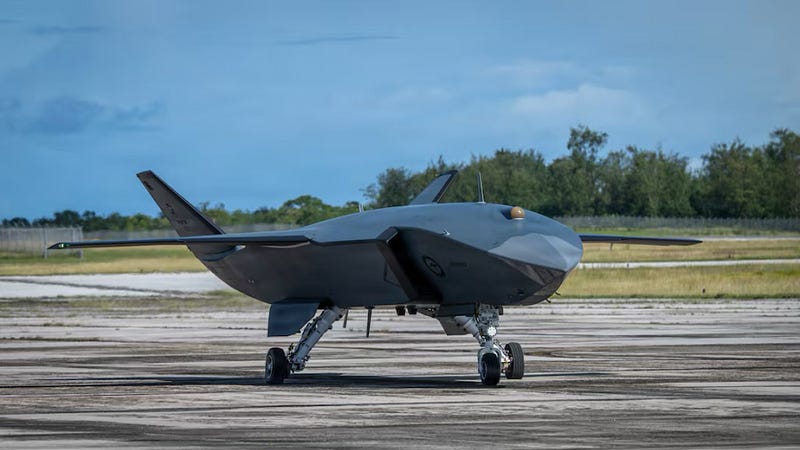
(Senior Airman Adrien Tran/U.S. Air Force)
Why it matters
For decades, fighter aircraft have relied on highly trained pilots to dominate the skies. Now, that equation is changing.
At the 2026 Farnborough International Airshow, Boeing’s MQ-28 Ghost Bat made its public debut at one of the world’s most influential aerospace events. While it looks like a compact fighter jet, there is one major difference: nobody sits inside.
Its appearance is more than an aircraft display – it reflects how future air forces are preparing for an era where humans and autonomous aircraft operate together.
⸻
Ghost Bat has already flown alongside F-35 fighters
Unlike many future concepts displayed at airshows, the MQ-28 is no longer just an experimental program.
The aircraft recently participated in Exercise Valiant Shield 2026 in the Western Pacific, flying alongside coalition F-35A and F-35B fighters during multinational operations.
According to Boeing, the aircraft supported the U.S. Air Force’s Experimental Operations Unit and helped validate tactics for collaborative combat aircraft (CCA), a new generation of autonomous aircraft designed to work with human pilots rather than replace them.
Earlier this year, the Ghost Bat also successfully demonstrated its combat capability by launching an AIM-120 AMRAAM missile during a live-fire test and destroying an aerial drone.
⸻
Designed to be a loyal teammate
The MQ-28 was built in Australia to extend the reach of crewed aircraft.
With a range exceeding 2,000 nautical miles and an operating altitude above 40,000 feet, it can perform missions including:
- Intelligence, surveillance and reconnaissance
- * Electronic warfare
- * Airspace sensing
- * Acting as an additional sensor or weapons platform
- * Reducing risk for human pilots in dangerous environments
Instead of replacing fighter pilots, autonomous aircraft like the Ghost Bat are intended to take on the most hazardous tasks while allowing pilots to focus on command decisions.
⸻
Farnborough highlights a global shift
The Ghost Bat was not alone.
This year’s Farnborough Airshow showcased numerous signs that autonomous air combat is becoming a central theme of military aviation.
BAE Systems introduced a next-generation pilot helmet designed to help manage multiple autonomous “wingmen.”
Meanwhile, the U.S. Air Force has formally selected Anduril’s FQ-44A Fury and General Atomics’ FQ-42A as its Collaborative Combat Aircraft, with both models also appearing at the exhibition.
The message across the industry is increasingly clear:
Future air superiority may depend less on having more fighter pilots and more on effectively coordinating networks of crewed and uncrewed aircraft.
⸻
Taiwan and Indo-Pacific perspective
For the Indo-Pacific region, the emergence of collaborative combat aircraft deserves close attention.
Future military competition may increasingly rely on artificial intelligence, networking and autonomous systems rather than simply larger numbers of traditional fighter aircraft.
For Taiwan, this trend reinforces the growing importance of integrating unmanned systems, electronic warfare and distributed operations into future defense planning.
At the same time, these technologies also raise broader questions. As autonomous systems become more capable, governments and societies must carefully consider how they are employed, ensuring technological advances contribute to deterrence and stability rather than making armed conflict easier to initiate.
Ultimately, the value of these systems should be measured not by how effectively they wage war, but by whether they help prevent it.
⸻
Final thoughts
The MQ-28 Ghost Bat represents more than another military aircraft.
It is an early glimpse into how artificial intelligence, autonomy and human decision-making may reshape air combat over the coming decades.
Whether these technologies become tools that strengthen deterrence – or accelerate future conflicts – will depend on the choices made by governments, militaries and international institutions.
Originally published on Medium on July 23, 2026.
 Asia Horizon Review