By E.K KING
As electric aviation moves closer to commercial reality, companies are beginning to look beyond crowded cities and toward island destinations where short-distance flights could provide immediate value.
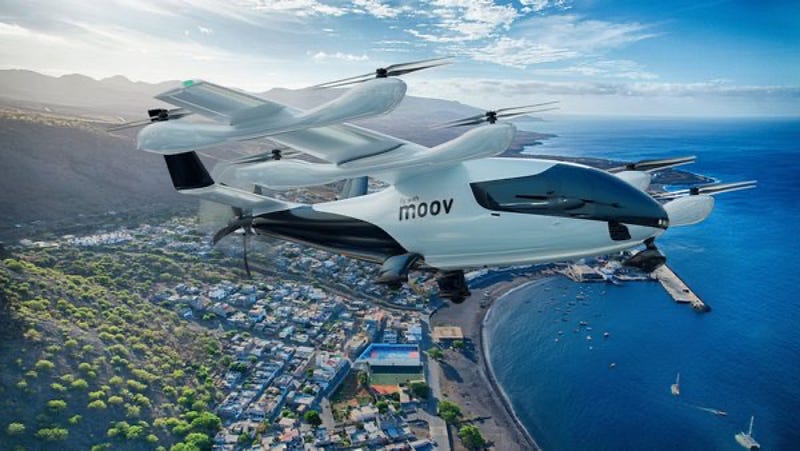
At the 2026 Farnborough International Airshow, Eve Air Mobility and Swiss aviation company Moov announced a Letter of Intent (LOI) covering up to 30 electric vertical take-off and landing (eVTOL) aircraft. While the agreement is non-binding, it signals growing confidence that advanced air mobility (AAM) may first succeed in tourism-focused regions rather than dense metropolitan areas.
Why Cabo Verde?
Located off the west coast of Africa, Cabo Verde is an archipelago of ten volcanic islands spread across the Atlantic Ocean. The country’s economy relies heavily on tourism, and transportation between islands remains an important challenge.
According to the World Bank, Cabo Verde welcomed approximately 1.18 million tourists in 2024, representing a 16.5% year-over-year increase. As visitor numbers continue to grow, improving regional connectivity has become a national priority.
For Eve and Moov, this combination of expanding tourism, island geography, and ongoing infrastructure investment creates an attractive environment for evaluating next-generation air transportation.
What Would the eVTOL Aircraft Do?
Rather than focusing solely on the often-discussed concept of urban air taxis, the companies are exploring several practical applications, including:
- Scenic sightseeing flights
- * Airport-to-resort shuttle services
- * Connections between ports, airports, and hotels
- * Inter-island transportation
- * Medical transport
- * Infrastructure inspection missions
The evaluation will include operations across several major islands, including São Vicente, Santo Antão, Sal, Praia, and Boa Vista.
If successful, these services could reduce travel times while offering visitors an entirely new perspective of the archipelago.
A Shift in the eVTOL Business Model
For years, many eVTOL developers promoted the vision of urban air taxis flying above congested city streets.
However, commercialization has proven more challenging than initially expected.
Urban operations require complex air traffic management, dense charging infrastructure, regulatory approval, noise mitigation, and significant public acceptance.
Island tourism presents a different opportunity.
Routes are generally shorter and more predictable, passenger demand is easier to forecast, and operations can be concentrated around airports, resorts, and popular tourist destinations. These characteristics may allow operators to introduce commercial eVTOL services sooner than in large metropolitan areas.
The Cabo Verde initiative reflects this broader shift in industry strategy.
More Than an Aircraft Order
Although the announcement mentions up to 30 aircraft, it is important to recognize that this is not a purchase contract.
The agreement is currently a Letter of Intent (LOI), meaning both companies will continue assessing:
- Commercial viability
- * Infrastructure requirements
- * Operating models
- * Regulatory considerations
- * Market demand
No delivery schedule or financial details have been disclosed.
Like many emerging AAM projects worldwide, the success of the initiative will depend not only on aircraft certification but also on the development of vertiports, charging networks, airspace integration, and supportive regulations.
Why This Matters Beyond Africa
The implications extend well beyond Cabo Verde.
Many countries with island territories face similar transportation challenges, making them potential early adopters of eVTOL technology.
For Taiwan, destinations such as Penghu, Kinmen, Matsu, Green Island, and Orchid Island could one day benefit from advanced air mobility if aircraft achieve commercial certification and operating costs become competitive.
Rather than replacing conventional aviation, eVTOL aircraft may serve as an additional layer of regional transportation – particularly where ferry schedules are limited or airport infrastructure is constrained.
Looking Ahead
The Eve – Moov partnership illustrates how the advanced air mobility industry is gradually moving from futuristic concepts toward practical, market-specific applications.
Whether Cabo Verde ultimately becomes one of the world’s first successful island eVTOL networks remains uncertain. Yet the project highlights an important trend: the first commercially viable electric air taxi services may emerge not above the skylines of megacities, but over the coastlines of island nations.
As certification progresses and infrastructure evolves, tourism-driven mobility could become one of the industry’s earliest and most realistic paths to commercial success.
⸻
What do you think?
Would you choose an electric air taxi for island travel if it were certified safe and reasonably priced? Could destinations like Taiwan’s offshore islands become the next frontier for advanced air mobility?
Originally published on Medium on July 19, 2026.
 Asia Horizon Review