By E.K KING
The U.S. Air Force’s latest fighter engine initiative isn’t simply about replacing aging hardware. It reflects a strategic shift toward rebuilding America’s defense industrial base – one that could reshape aerospace supply chains across the Indo-Pacific.
⸻
The Next Battlefield May Be the Factory Floor
For decades, military competition has focused on who could build the fastest aircraft or field the most advanced weapons.
Today, the U.S. Air Force is sending a different message.
Its newest Request for Information (RFI) for fighter aircraft engines is less about developing a more powerful engine and more about fixing something far less visible – but arguably more important: the industrial system behind America’s airpower.
The document acknowledges that persistent production delays, quality-control failures, obsolete components, and fragile supply chains have become strategic problems rather than routine manufacturing issues.
In modern warfare, an aircraft waiting for an engine is just as unavailable as one damaged in combat.
⸻
When Industrial Capacity Becomes Military Capability
Recent aircraft programs have exposed weaknesses that can no longer be ignored.
The F-35 has experienced repeated delivery and modernization delays linked to engine availability, while the B-52 re-engining program has faced billions of dollars in additional costs and significant schedule setbacks.
These are not isolated engineering failures.
They reveal a broader reality: military superiority depends not only on designing advanced systems but also on producing, maintaining, and sustaining them at scale.
Recognizing this, the Air Force is moving away from traditional procurement practices that emphasized acquisition cost above all else.
Instead, future engine competitions will evaluate manufacturers on their ability to deliver reliable production, resilient supply chains, easier maintenance, and lower lifecycle costs.
The initial focus covers engines supporting the F-15EX and F-16 fleets, with annual procurement expected to exceed 180 engines by 2034.
The underlying objective, however, is much larger than replacing aging powerplants.
It is about rebuilding confidence in America’s defense manufacturing ecosystem.
⸻
Critical Materials Are Now Strategic Assets
Perhaps the most revealing section of the RFI is not about engines at all.
Instead, it asks manufacturers about their access to titanium alloys, nickel-based superalloys, advanced casting, and precision forging capacity.
These questions highlight an increasingly important reality.
The future of military aviation may depend as much on metallurgy and industrial infrastructure as on aerodynamics.
As geopolitical competition intensifies and critical material supply chains become more contested, governments are paying closer attention to where essential components originate and how resilient those supply networks truly are.
Industrial resilience has become a national security issue.
⸻
Why Asia Should Pay Attention
For Asia, this development extends well beyond U.S. defense procurement.
A stronger emphasis on diversified manufacturing could create new opportunities for aerospace suppliers throughout the Indo-Pacific, particularly in precision machining, advanced materials, and high-value component manufacturing.
At the same time, it reinforces a lesson many Asian economies have already learned through the pandemic and recent geopolitical disruptions.
Overdependence on a single supplier – even during peacetime – can become a strategic vulnerability.
Whether the industry is commercial aviation, semiconductors, or defense manufacturing, resilient supply chains are increasingly viewed as essential infrastructure rather than simply an economic advantage.
⸻
Beyond Engines
The most important takeaway from the Air Force’s announcement is that future military competition may not be decided solely by aircraft performance.
It may instead depend on whether factories can sustain production, suppliers can weather geopolitical shocks, and industrial ecosystems can continue operating under pressure.
For Asia, where economic prosperity and regional stability remain deeply interconnected, this shift carries an important message.
Strengthening industrial resilience is not about preparing for conflict.
It is about reducing strategic risk, protecting technological progress, and helping ensure that economic cooperation remains stronger than geopolitical disruption.
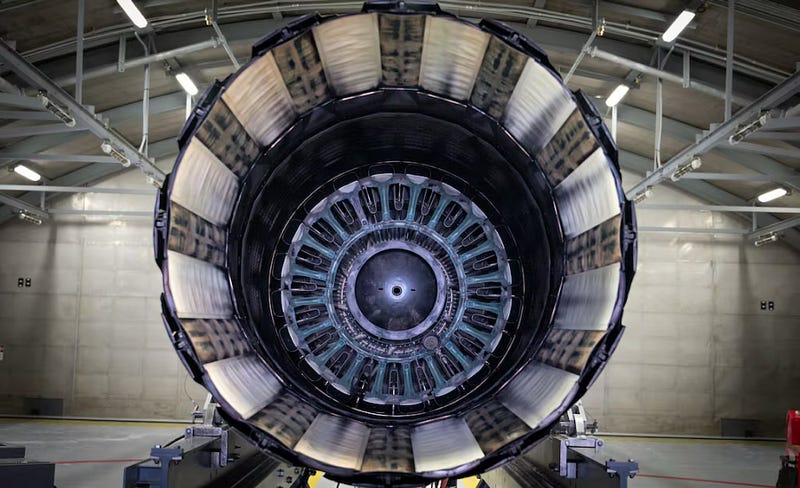
(Micah Garbarino/U.S. Air Force)
Originally published on Medium on August 4, 2026.
 Asia Horizon Review