The lineup moved from joint drills to the El Alamein airshow.
By E.K KING
Four Chinese Aircraft Types Made Their Overseas Airshow Debut. The Bigger Story Is What Happened Before.
A KJ-500, J-16, YY-20A and Z-20K moved straight from China-Egypt drills to the El Alamein airshow, linking training, long-range deployment and military display.
China did not send a lone display aircraft to Egypt.
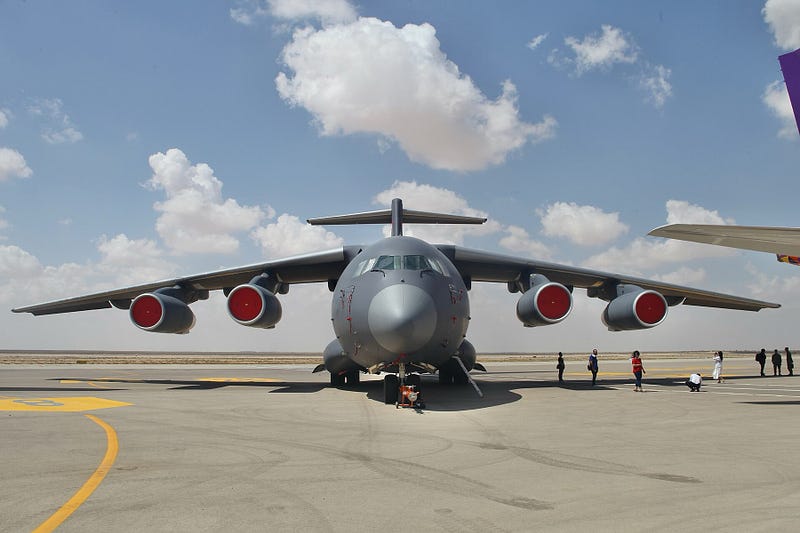
A Chinese Air Force Y-20 at El Alamein International Airport in 2024. Contextual image; the aircraft is not the YY-20A shown at the 2026 airshow. Photo: Colin Cooke Photo / Wikimedia Commons / CC BY-SA 2.0. Four types of operational aircraft – the KJ-500, J-16, YY-20A and Z-20K – moved from a joint China-Egypt air exercise to the second El Alamein International Airshow. Chinese state media said this was the first time all four types had been publicly displayed at an overseas airshow.
The important part is not the lineup on the ground. China brought airborne warning, combat aviation, aerial refuelling and battlefield rescue capabilities to Africa at the same time.
This was not a full combat deployment. But it was more meaningful than sending one aircraft abroad for a flying display.
What the four aircraft contribute
The KJ-500 is an airborne early-warning and command aircraft. In plain language, it carries a large radar into the sky, helping crews detect aircraft earlier and distribute information to fighters and ground units.
The J-16 is a twin-seat, twin-engine multirole fighter used for air-to-air and strike missions. Reuters independently confirmed that a J-16 appeared at the El Alamein airshow. The aircraft had also taken part in the preceding China-Egypt drills, its first deployment to Africa.
The YY-20A is an aerial tanker derived from the Y-20 transport aircraft. It does not add firepower directly. It allows fighters to fly farther or remain airborne longer by transferring fuel in flight.
The Z-20K is a medium military helicopter operated by the Chinese air force. The Chinese report placed it in the battlefield search-and-rescue role, although Beijing did not publish the aircraft’s full configuration at the show.
Together, the four types cover four basic needs: seeing farther, fighting, extending range and recovering personnel. Chinese authorities did not disclose how many aircraft of each type travelled to Egypt, and there is no evidence that the four performed a complete integrated combat demonstration at the airshow.
Why the move from exercise to airshow matters
A Chinese participant quoted by the PLA Daily said the aircraft travelled several thousand kilometres to reach Egypt. Beijing used that claim to highlight aircraft reliability and the air force’s ability to operate far from home.
The route, departure bases, stopovers, tanker support and maintenance footprint were not disclosed. The public information therefore cannot show how the entire movement was supported.
The clearest point is that the contingent did not return home immediately after the exercise. It remained in Egypt and moved directly into the airshow. The same aircraft and personnel supported training, military diplomacy and public display during one overseas deployment.
Why Egypt matters
Egypt is a major US security partner and receives about $1.3 billion in American military aid each year. It also operates French-built Rafale fighters. That makes it one of the few countries where Chinese aircraft can train near Western-made systems.
Reuters reported that the joint exercise included air-combat drills involving Chinese J-16s and Egyptian Rafales. A Chinese tanker was also photographed refuelling an Egyptian Rafale.
That does not prove China obtained sensitive information about Western equipment. It does show that the two air forces are building unusual cross-platform experience.
El Alamein is also more than an airshow venue. Egypt presents the exhibition as a gateway to defence markets in Africa and the Middle East. Chinese, Russian, Turkish, Emirati and Egyptian exhibitors were present this year.
For Beijing, the appearance served two purposes: deepen military ties with Cairo and show potential customers that large Chinese aircraft can reach and operate in the region.
Do not mistake a display for a sale
There is no public evidence that Egypt plans to buy the J-16, KJ-500, YY-20A or Z-20K. Some of these aircraft contain sensitive technologies and may not be available for export.
A static display also does not prove China can sustain a long overseas air campaign. Expeditionary operations require spare parts, maintenance teams, munitions, base access and a reliable supply system. The Chinese report provided no details about those requirements.
The safest conclusion is narrower. China’s air force is becoming more comfortable linking overseas exercises, long-distance movements and international airshows in a single deployment.
The next question is whether similar packages will appear elsewhere in the Middle East or Africa – and whether airborne refuelling and early-warning aircraft become regular participants in China’s overseas drills.
Originally published on Medium on September 11, 2026.
 Asia Horizon Review