Iran damaged U.S. aircraft in Jordan as concerns grow over shrinking Patriot missile stocks.
By E.K KING
Iran’s strike on a U.S.-used air base in Jordan damaged American aircraft and exposed the mounting cost of defending bases from repeated missile attacks.
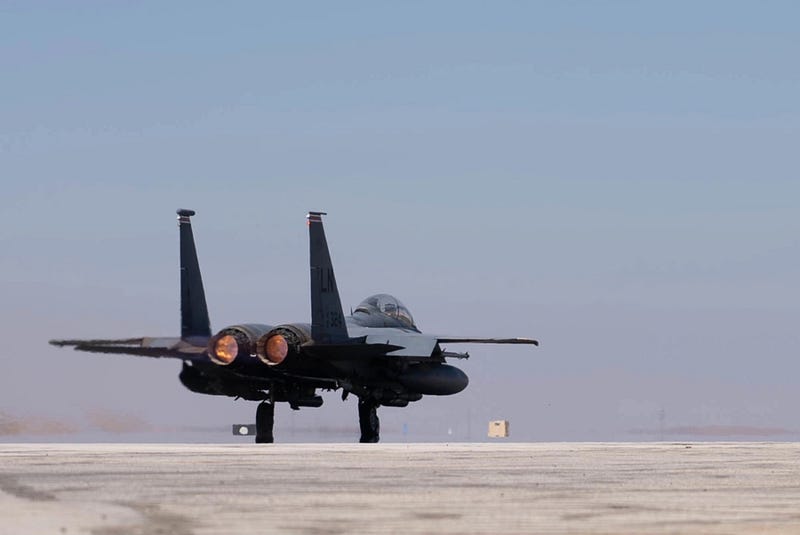
A U.S. Air Force F-15E Strike Eagle assigned to the 332nd Air Expeditionary Wing departs on a combat sortie in October 2021. This is a file photo and does not show the aircraft damaged in the Iranian strike on Muwaffaq Salti Air Base. U.S. Air Force photo by Senior Airman Jack Layman via DVIDS. Public domain.
Iran attacked a U.S.-used air base in Jordan this week. American forces reportedly fired about 30 Patriot interceptors in response.
One A-10 attack aircraft was left without a wing. Roughly eight F-15 fighters also suffered light damage, although they were quickly returned to service.
If all 30 interceptors had been PAC-3 missiles priced at an estimated $4 million to $5 million each, their combined value would be between $120 million and $150 million. The United States has not disclosed which Patriot variants were fired, so that figure is a measure of scale, not an official bill for the engagement.
The aircraft damage attracted immediate attention. The harder question is how quickly the United States is consuming the missiles used to protect its bases.
An A-10 Lost a Wing. Eight F-15s Returned to Service
Iranian strikes hit Muwaffaq Salti Air Base in eastern Jordan, damaging several American military aircraft.
An A-10 Thunderbolt II, better known as the Warthog, suffered the heaviest damage. A U.S. official said the aircraft was struck and left with a missing wing. The Pentagon has not released a full damage assessment or said whether it can be repaired.
The A-10 was designed to fly low and support troops on the ground. Production ended decades ago, which could make major structural repairs difficult even if the rest of the aircraft survived.
About eight F-15 fighters sustained light damage. They were inspected or repaired and returned to service, according to the initial Reuters report.
The available reporting does not establish whether the aircraft were hit directly by Iranian missiles, damaged by nearby explosions, or struck by debris after interceptions. What can be confirmed is that the base suffered damage despite a large defensive response.
Why Did 20 Incoming Missiles Require About 30 Interceptors?
Jordan said Iran launched 20 missiles toward the base and that 18 were intercepted.
A U.S. official said American forces fired roughly 30 Patriot interceptors during the attack.
Air defense crews sometimes fire two interceptors at one target. If the first misses or fails to destroy the incoming missile, the second provides another chance. Crews facing ballistic missiles have only minutes to identify the threat and decide whether to fire.
That approach raises the probability of a successful interception. It also drains missile stocks quickly.
The Patriot system can use several interceptor types. The newer PAC-3 destroys its target through direct impact and costs an estimated $4 million to $5 million per missile. Washington has not disclosed the exact combination used over Jordan, making a precise cost calculation impossible.
A complete newly produced Patriot battery, including its missiles, costs more than $1 billion, according to a Reuters overview of the system.
The expense does not end when the attack is over. Every missile fired must eventually be replaced, tested and delivered. The base must also retain enough interceptors for the next Iranian barrage.
Did the U.S. Stockpile Fall From 2,330 to Fewer Than 850?
The Pentagon does not publish the current number of Patriot interceptors in the U.S. inventory.
The Center for Strategic and International Studies estimated that American forces expended about 65% of their Patriot interceptors between February and July. According to that estimate, the stockpile fell from roughly 2,330 before the war to fewer than 850.
Those are not official inventory figures. Deliveries of newly manufactured missiles, differences between Patriot variants and weapons held by U.S. allies could change the actual total.
At a rate of 30 interceptors per attack, a stockpile of 850 would cover only 28 engagements of similar size. In practice, those missiles cannot all be sent to Jordan. The United States must also defend other bases, ports and critical facilities across the Middle East while maintaining reserves for threats elsewhere.
Iran does not have to destroy an American fighter in every attack. Repeated launches can force U.S. crews to keep firing expensive interceptors and place sustained pressure on American production lines.
At Least 42 U.S. Aircraft Had Already Been Lost or Damaged
The A-10 in Jordan is the latest addition to a growing list of American aviation losses.
A May report from the Congressional Research Service, cited by Reuters, found that at least 42 U.S. military aircraft had already been lost or damaged in the conflict. The total included fighters, refueling aircraft and drones.
More than two dozen of those aircraft were unmanned. Manned aircraft have also been lost to Iranian fire, friendly fire and accidents.
A Reuters assessment published six months into the war found that the conflict was reducing U.S. military readiness as aircraft losses, missile consumption and extended deployments accumulated.
Since the war began in late February, 18 American service members have been killed and more than 800 injured, according to the latest figures cited in reports on the conflict.
The CRS aircraft count was published in May. It does not include the A-10 and F-15s damaged in Jordan this week.
Attacks on a Warship Led to Tankers — Then an Air Base
The latest strike followed another round of retaliation at sea.
The United States said it destroyed five Iranian crude oil carriers after Iran’s Islamic Revolutionary Guard Corps twice targeted a U.S. Navy warship with ballistic missiles over the previous two days.
Iran then attacked the base in Jordan and ships near the Strait of Hormuz. The escalation has added new risks to one of the world’s most important energy routes.
According to Reuters, Jordan intercepted 18 of the 20 missiles launched toward the base.
A U.S. warship came under fire. Five Iranian oil carriers were destroyed. The next Iranian response reached aircraft parked at an air base.
The lightly damaged F-15s are already flying again, and the U.S. military can replace aircraft in the region if necessary. Patriot interceptors cannot be replenished as quickly as they are being fired.
If Iran launches another 20 missiles, will the United States need to expend another 30 Patriots?
The estimate of fewer than 850 remaining interceptors may not be exact. It nevertheless captures the problem facing U.S. commanders: how many more attacks can be defended at this rate?
Originally published on Medium on September 11, 2026.
 Asia Horizon Review