With Hormuz oil flows down roughly 90% and 89% bound for Asia, tankers are becoming a new front line.
By E.K KING
With oil flows through the Strait of Hormuz down roughly 90% from normal levels – and 89% of its crude and condensate bound for Asia – tankers are becoming a new front line in the U.S.-Iran conflict.
On September 8, the U.S. military sank five Iranian crude oil tankers.
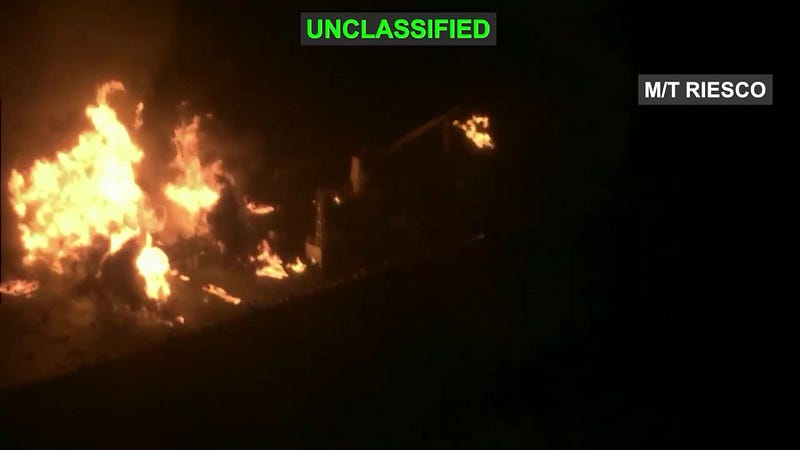
M/T Riesco burns after a U.S. military strike, September 8, 2026. Photo: U.S. Central Command/DVIDS (Public Domain).
Less than a day later, Iran’s Islamic Revolutionary Guard Corps claimed it had retaliated against 10 vessels, including two U.S. warships and eight tankers. At least one seafarer was reported killed, while another remained missing.
Brent crude then climbed above $100 a barrel for the first time since July.
This is not a conflict whose consequences will be confined to American gas stations.
In normal times, roughly 20 million barrels of oil pass through the Strait of Hormuz each day. The narrow waterway connecting the Persian Gulf with the Gulf of Oman is one of the world’s most important energy chokepoints.
Recent flows have fallen to about 2 million barrels per day – around 90% below normal levels.
More importantly for Asian readers, 89% of the crude oil and condensate moving through the strait is destined for Asian markets.
One of Asia’s most important energy routes is becoming an arena for direct U.S.-Iran retaliation.
Tankers Are Becoming Tools of Retaliation
U.S. Central Command said American forces destroyed five Iranian crude carriers on September 8.
Washington said the operation followed two Iranian ballistic missile attacks against a U.S. Navy warship over the previous two days. According to the United States, no American personnel were harmed.
U.S. Secretary of State Marco Rubio then made Washington’s position unusually clear: Every time Iran attacks or attempts to attack an American warship, it will lose more tankers.
That amounts to a new form of retaliation.
If Iran targets a U.S. warship, Washington’s response may no longer be limited to missile sites or other military facilities. Ships carrying Iranian oil can also be attacked.
A 43-second video released by U.S. Central Command shows several tankers burning. One was identified as the M/T Riesco. Reuters also reported on the operation.
Iran then claimed that the Revolutionary Guards had struck 10 vessels near the Strait of Hormuz: two U.S. warships and eight tankers.
The United States denied that its warships had been hit. But separate reports confirm that commercial vessels have come under attack across the region.
On September 9, the United Kingdom Maritime Trade Operations agency received a report that a tanker had been struck by an unknown object about 28 nautical miles southeast of Iraq’s Al-Faw port. Other vessels reported attacks or damage in waters near Iraq and the United Arab Emirates.
Iran’s claim that it struck all 10 ships has not yet been independently verified. Each incident still needs to be examined separately.
But the wider pattern of attacks on commercial shipping is real. UKMTO has classified the regional maritime threat as severe and continues to issue incident reports.
Iran has also warned that if its opponent attacks two or three Iranian targets, Tehran could respond against 20. The Revolutionary Guards said they were preparing to announce a much larger restricted maritime zone extending toward waters off Chabahar, near Pakistan.
The danger is no longer confined to the narrowest part of the Strait of Hormuz.
The Market Is Not Worried About Just Five Tankers
Following the attacks, Brent crude futures rose as high as $101.32 a barrel. U.S. West Texas Intermediate reached $96.48.
It was the first time Brent had crossed $100 since July, according to Reuters’ energy-market coverage.
The loss of five tankers alone is not enough to transform global oil supply.
What worries the market is what happens next.
How many shipowners will refuse to enter the area? How sharply will insurers raise war-risk premiums? Could ports, refineries and storage facilities become the next targets?
A shipping lane does not need to be physically sealed to become unusable.
If the ships still exist but nobody is willing to sail them through, the result begins to resemble a blockade.
Asia Will Feel the Impact in Four Places
The U.S. Energy Information Administration estimates that, during the first half of 2025, 89% of the crude oil and condensate passing through the Strait of Hormuz went to Asia.
China, India, Japan and South Korea were among the leading destinations.
The consequences will move through Asian economies along four paths:
Airlines will face higher fuel costs.
Shipping and logistics companies will pay higher war-risk premiums.
Petrochemical and manufacturing companies will face more expensive inputs.
Consumers will eventually feel the pressure through transport costs, electricity bills and higher prices.
For Asia, the central question is not simply how many dollars have been added to a barrel of crude.
It is whether this energy route can continue operating reliably.
One Tanker Can Connect More Than a Dozen Countries
When a warship comes under attack, the countries involved can at least examine radar data, missile trajectories and military communications to determine what happened.
Commercial shipping is far more complicated.
A tanker may sail under one country’s flag, be owned by a company in another, operated from a third and insured somewhere else. Its crew may come from several countries, while its cargo is bound for customers across Asia.
The attacker may see the vessel as a source of wartime revenue for an enemy.
The people on board may all come from countries that have no role in the war.
One mistaken identification – or a strike that kills a large number of foreign seafarers – could pull additional governments into what began as a confrontation between Washington and Tehran.
Oil above $100 is only the first bill the market has issued for that risk.
The more dangerous warning is that both the United States and Iran have now shown that the next round of retaliation may begin with tankers at sea.
. Sources
Reuters — U.S.-Iran tanker attacks:
U.S. Central Command — Five Iranian crude carriers destroyed:
https://www.centcom.mil/MEDIA/VIDEO-AND-IMAGERY/VIDEOS/dvpmoduleid/37619/videoid/1022155/
United Kingdom Maritime Trade Operations:
U.S. Energy Information Administration — World oil transit chokepoints:
Originally published on Medium on September 10, 2026.
 Asia Horizon Review