By E.K KING
Solvay plans to increase its electronic-grade hydrogen peroxide capacity in Taiwan from 35,000 tonnes to more than 70,000 tonnes by the end of 2026. The expansion reveals a rarely discussed part of the AI chip supply chain.
Belgian chemical company Solvay is preparing to more than double its production capacity for electronic-grade hydrogen peroxide in Taiwan.
Annual capacity will rise from 35,000 tonnes to more than 70,000 tonnes by the end of 2026.
But why would growing demand for artificial intelligence chips require more hydrogen peroxide?
Advanced chips depend on far more than powerful designs and expensive manufacturing equipment. Chipmakers also need large quantities of ultra-pure chemicals. As circuits become smaller, particles invisible to the human eye can reduce production yields or cause a chip to fail.
Solvay’s expansion shows how the AI boom is moving beyond companies such as Nvidia and TSMC and reaching the less visible suppliers behind semiconductor production.
Why Do Chip Factories Need Hydrogen Peroxide?
Most people know hydrogen peroxide as a common cleaning or disinfecting product. Semiconductor factories use a much purer version known as electronic-grade hydrogen peroxide.
A chip is not created in a single step. During production, a silicon wafer repeatedly goes through processes such as deposition, lithography, etching and cleaning. These steps gradually build extremely complex circuits on its surface.
After certain stages, manufacturers must remove chemical residue, metal ions and microscopic particles from the wafer.
This becomes increasingly difficult as chip features shrink to the nanometer scale. Even a tiny amount of contamination can damage a circuit and reduce the number of usable chips produced from each wafer.
The purity and consistency of cleaning chemicals therefore have a direct effect on production.
According to Reuters, the expansion will be carried out by Shinsol Advanced Chemicals, a joint venture between Solvay and Taiwan-based Shinkong Synthetic Fibers. Solvay owns 51 percent of the venture.
The companies announced their partnership in 2021, and the plant began operations in 2023. Only a few years later, its production capacity is already set to more than double.
Why Expand in Tainan?
The Shinsol plant is located in the Tainan Technology Industrial Park, close to the Southern Taiwan Science Park.
Tainan has become one of Taiwan’s most important centers for advanced semiconductor manufacturing. Chip factories in the region are surrounded by equipment companies, chemical producers, component suppliers and engineering service providers.
For high-purity chemicals, location matters.
Some materials require careful storage, transportation and safety controls. A nearby supplier can shorten delivery times and respond more quickly when a chipmaker changes its production schedule or encounters a manufacturing problem.
Local production can also reduce some of the risks created by shipping delays or disruptions in overseas supply.
Solvay said the electronic-grade hydrogen peroxide produced in Taiwan has already been qualified by local customers. Qualification is an important step because a material must meet strict requirements for purity, consistency and reliability before it can enter a semiconductor production line.
The AI Boom Is Moving Upstream
Public discussion about AI chips usually focuses on Nvidia, TSMC or ASML, the Dutch company that makes advanced lithography machines.
But semiconductor factories also depend on specialty gases, photoresists, polishing liquids, silicon wafers, ultra-pure chemicals and thousands of precision components.
A shortage or quality problem in any of these areas can slow production.
Solvay’s investment suggests that AI-related expansion is spreading upstream through the supply chain. When chipmakers increase advanced manufacturing, their demand for wafer-cleaning chemicals rises as well.
The same pattern is appearing in other major semiconductor markets.
Solvay is expanding related capacity in Germany and preparing to serve more customers in the United States. The company also expanded an electronic-grade hydrogen peroxide facility in China in 2025.
As Taiwan, the United States, China and Europe invest in semiconductor production, material suppliers have an incentive to build facilities close to their customers.
The global chip competition now reaches well beyond chip design and wafer fabrication. It increasingly includes materials, manufacturing equipment, energy, logistics and skilled workers.
What Does the Expansion Mean for Taiwan?
The investment will strengthen Taiwan’s local supply of high-purity chemicals and reduce some dependence on long-distance deliveries.
It also highlights the value of Taiwan’s semiconductor ecosystem.
Chip manufacturing, equipment maintenance, material production, engineering talent and logistics services are concentrated within a relatively small area. Suppliers can work closely with customers, and problems can often be addressed more quickly.
This concentration is one reason Taiwan’s semiconductor position cannot easily be reproduced elsewhere simply by constructing new factories.
However, the expansion also raises questions that deserve further attention.
Semiconductor and chemical production require industrial water, energy, chemical storage and wastewater treatment. Solvay’s announcement did not provide figures for the expanded facility’s water consumption, energy use or environmental impact.
It is therefore too early to determine how much additional pressure the project could place on local resources.
For Taiwan, attracting more semiconductor investment is only part of the challenge. Electricity supply, water availability and environmental management must also keep pace with industrial growth.
The AI chip race may appear to take place inside data centers and the headquarters of major technology companies. Behind it stands a much larger network of factories and suppliers.
Solvay’s plan to more than double its Taiwan capacity sends a clear signal: if the world wants more AI chips, the entire production chain must expand with them.
The next time we discuss AI performance, it may be worth looking beyond the processors themselves – and at the ordinary-looking materials without which those processors could never be made.
⸻
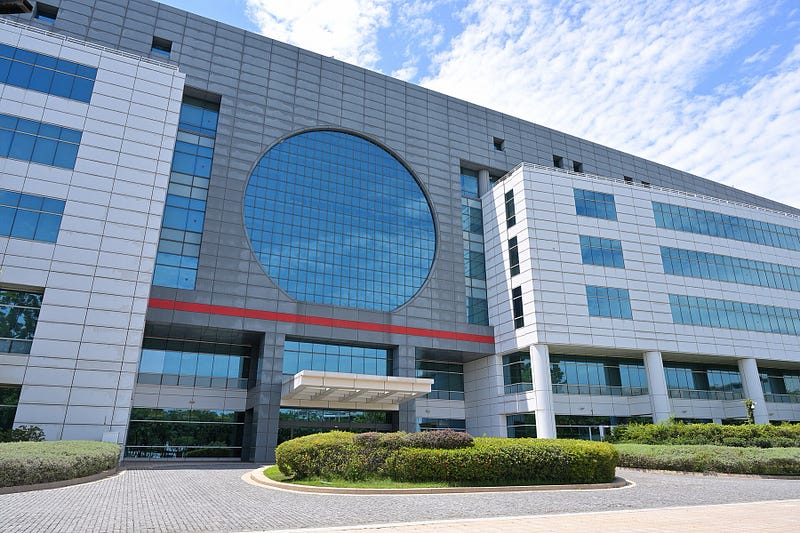
TSMC Fab 6 at the Southern Taiwan Science Park in Tainan. The image illustrates Taiwan’s semiconductor manufacturing ecosystem and does not show the Solvay or Shinsol facility. Photo: 4300streetcar / Wikimedia Commons, CC BY 4.0. Cropped from the original.
Originally published on Medium on September 4, 2026.
 Asia Horizon Review