By E.K KING
North Korean forces are gaining something money cannot easily buy: experience in a modern war. What they bring home could matter far beyond Ukraine.
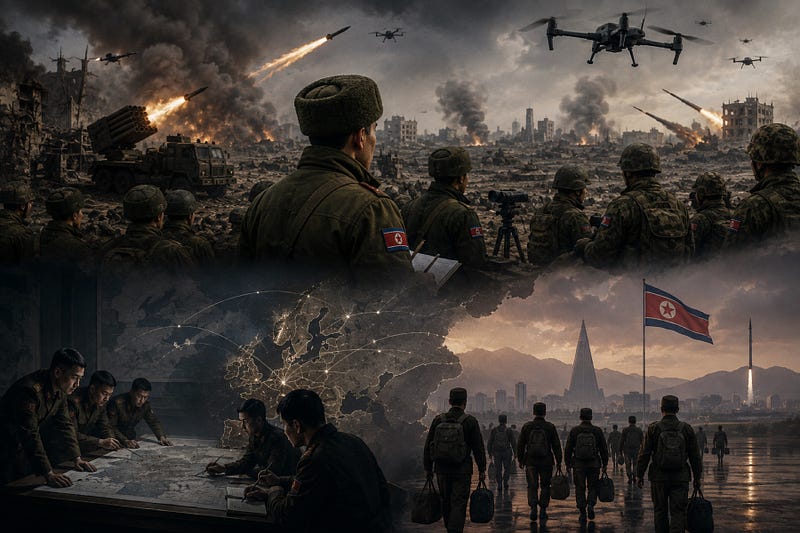
For decades, North Korea has built one of the world’s largest militaries without fighting a major modern war.
Ukraine may be changing that.
North Korea’s support for Russia has already moved well beyond shipments of artillery shells and missiles. North Korean soldiers have fought alongside Russian forces, and Ukrainian intelligence now says Pyongyang is preparing to deploy a missile unit to Russia — another sign that the relationship is becoming increasingly operational.
The immediate impact will be felt in Ukraine.
The longer-term consequences may emerge thousands of kilometers away, on the Korean Peninsula.
From weapons supplier to battlefield participant
According to reporting published by Defense News, citing Reuters, Ukrainian intelligence says a North Korean missile unit of roughly 90 personnel is being deployed to western Russia.
The unit could operate up to six launchers and as many as 120 ballistic missiles. Around 40 missiles have reportedly already been transferred to Russia.
These claims have not all been independently verified, an important caveat in a war where battlefield information is often difficult to confirm.
But the missile deployment fits a much larger pattern.
North Korea has supplied Russia with artillery ammunition, ballistic missiles and other military equipment. Pyongyang has also sent thousands of troops, some of whom have participated in combat operations in Russia’s Kursk region.
Moscow and Pyongyang are therefore building something deeper than an arms transaction.
They are building wartime experience together.
What North Korea can learn in Ukraine
This may ultimately be the most important part of the story for Asia.
A military can conduct exercises for decades. It can test missiles, rehearse attacks and simulate enemy responses.
Actual combat exposes weaknesses that exercises rarely reproduce.
North Korean personnel operating alongside Russian forces can observe how troops survive under constant drone surveillance, how electronic warfare affects communications, how artillery works with unmanned systems, how logistics function under long-range attack and how units adapt when the enemy changes tactics.
They can also see what fails.
Ukraine has become one of the world’s most intense testing grounds for drones, electronic warfare, battlefield sensors, precision weapons and rapidly evolving countermeasures.
Even costly battlefield failures can produce valuable lessons.
Those lessons do not necessarily remain in Europe.
Soldiers, officers and technicians eventually return home.
So does their experience.
The Korean Peninsula should be watching
This is why North Korea’s involvement deserves attention in Seoul, Tokyo and across the wider Indo-Pacific.
North Korea has traditionally possessed enormous quantities of artillery, missiles and manpower. Its weakness has been harder to measure: how effectively could those forces operate in a fast-moving modern conflict?
Ukraine offers at least some North Korean personnel an opportunity to find out.
That does not mean North Korea will suddenly emerge with a military comparable to Russia, the United States or South Korea. Battlefield lessons also cannot automatically be transferred from Ukraine to the Korean Peninsula, where geography, air power, naval forces and alliance structures are very different.
But even limited experience matters.
A military that discovers which tactics fail before its own country enters a war has learned something valuable.
For South Korea and Japan, the concern therefore goes beyond the number of artillery shells Pyongyang sends to Moscow.
The more difficult question is what Russia gives North Korea in return — whether through technology, training, operational knowledge or battlefield access.
Russia is gaining something too
The exchange works in both directions.
Russia needs ammunition, missiles and manpower to sustain a long war.
North Korea can provide all three.
That makes Pyongyang useful to Moscow even if North Korean weapons are less sophisticated than many Western systems.
Quantity still matters in an attritional war.
Every North Korean artillery shell that reaches Russian forces reduces pressure on Russia’s own production system. Every additional missile complicates Ukrainian air-defense planning. Additional personnel can free Russian troops for other missions.
The partnership therefore reflects a basic reality of prolonged warfare: countries eventually look beyond their traditional defense industries for whatever resources can keep the battlefield supplied.
That has allowed a European war to pull an East Asian military directly into its orbit.
A war can export experience
There is an uncomfortable lesson here.
Weapons are not the only things wars export.
They export tactics, experience and people who have learned how to fight.
North Korean involvement in Ukraine illustrates how a conflict can reshape military capabilities far beyond the countries where the fighting actually takes place.
Russia may receive ammunition and manpower today.
North Korea may receive something whose effects are harder to measure: soldiers and officers who have seen a modern battlefield with their own eyes.
For Asia, that may prove more consequential than another shipment of missiles.
The danger is not that war in Ukraine is physically moving toward the Korean Peninsula.
It is that some of its lessons already are.
⸻
Originally published on Medium on August 9, 2026.
 Asia Horizon Review