The answer lies inside a $464.8 million contract – and in what the Army learned from heat, dust, and disappointed soldiers.
By E.K KING
Two years ago, the U.S. Army sent four 50-kilowatt laser weapons to the Middle East.
Mounted on Stryker armored vehicles, they were supposed to shoot down drones. Their power looked impressive on paper. The soldiers testing them were less impressed.
Now the Army is spending $464.8 million to produce dozens of new counter-drone lasers.
The surprising part is that the new weapon is not more powerful.
It is rated at just 30 kilowatts.
Why would the Army spend nearly half a billion dollars on a laser that appears weaker than the one that struggled in the field?
The answer reveals something often missing from weapons demonstrations:
The most powerful laser in a laboratory is not always the one soldiers can actually use.
The moment military lasers leave the test range
On September 2, the U.S. Army awarded AeroVironment a production contract for the Enduring-High Energy Laser program, known as E-HEL.
Over the next several years, the company will deliver dozens of LOCUST X3 laser weapon systems, along with training and operational support.
The amount of money matters, but the type of contract matters even more.
The Army describes it as its first production contract for a high-energy laser weapon. AeroVironment goes further, calling it the first production contract for a directed-energy system in U.S. history.
The wording is slightly different, but the direction is clear.
This is no longer an experiment involving a handful of prototypes. The Army intends to turn laser weapons into equipment that units can receive, operate and maintain.
Military lasers have been “almost ready” for decades.
They have burned through targets during demonstrations, destroyed drones at test ranges and appeared regularly in presentations about the future of warfare. Moving from a controlled test to routine military service has proved much harder.
LOCUST X3 is now expected to cross that gap.
The 30-kilowatt system is designed primarily to engage Group 1 to Group 3 unmanned aircraft. That broad category includes small hand-launched reconnaissance drones as well as larger tactical aircraft approaching the size of the RQ-7 Shadow.
Unlike a missile launcher, the laser does not carry a rack of physical interceptors. It directs energy at a vulnerable point on the drone and holds the beam there until the airframe, sensor or another critical component fails.
As long as the system has electrical power and can manage the heat it produces, it can fire again.
That gives lasers an obvious advantage in the drone age.
A missile disappears after one launch. A laser’s “magazine” can be replenished by its power supply.
When an attacker uses drones costing thousands or tens of thousands of dollars to force the defender to launch much more expensive missiles, every successful interception can still become a financial loss.
The wars in Ukraine and the Middle East have turned that imbalance from a theoretical concern into a daily operational problem.
The Army needs a weapon that can engage large numbers of inexpensive drones without rapidly exhausting its missile inventory.
Laser weapons appear to offer exactly that.
The difficult part is keeping them working outside the test range.
Why 50 kilowatts lost to 30
In 2024, the Army deployed four Directed Energy Maneuver Short-Range Air Defense prototypes to the Middle East.
Known as DE M-SHORAD, each system combined a 50-kilowatt laser with a Stryker armored vehicle. The prototypes were intended to engage Group 1 to Group 3 drones, along with rockets, artillery shells and mortar rounds.
The initial feedback was not encouraging.
The problem was not simply whether the laser could hit a target. It was whether the entire system could continue operating under real battlefield conditions.
A 50-kilowatt laser demands a large amount of power and produces a great deal of heat. Integrating that equipment into an armored vehicle that must move constantly, cross rough ground and survive high temperatures is far more difficult than operating it at a fixed test site.
Doug Bush, then the Army’s acquisition chief, told lawmakers that heat dissipation, electronics and the wear and tear of the tactical environment were proving challenging for the Stryker-mounted system.
Middle Eastern dust made matters worse.
A laser destroys a drone by concentrating energy on a small area for long enough to damage it. Dust, smoke, moisture and other particles in the air can disturb the beam and reduce the amount of energy reaching the target.
A weapon labeled “50 kilowatts” therefore does not necessarily deliver all that power to a drone several kilometers away.
Higher power also brings heavier electrical equipment, more demanding cooling systems and a larger maintenance burden.
At a permanent base, those costs may be manageable. On a vehicle expected to move with frontline troops, they can determine whether the weapon is useful at all.
The Army’s experience began pointing toward a more practical range: somewhere around 20 to 30 kilowatts.
A system in that class may be less destructive, but it is easier to install on a smaller vehicle and less demanding to power and cool. Against the small drones that make up much of today’s threat, that may be enough.
This is why the decision to produce the 30-kilowatt LOCUST X3 should not be read as the Army lowering its ambitions.
It is redefining what a more capable weapon looks like.
A 50-kilowatt laser that frequently overheats, requires delicate maintenance or performs poorly in dust offers little value to soldiers, regardless of the number in its specifications.
A 30-kilowatt laser that can travel with a unit, survive field conditions and keep firing may be far more useful.
LOCUST X3 also avoids being tied to one vehicle.
The Army plans to integrate it with the Joint Light Tactical Vehicle, or JLTV. It can also be used in palletized configurations at fixed or semi-fixed positions. AeroVironment is studying whether it could eventually be placed on the lighter Infantry Squad Vehicle.
That flexibility would allow the same weapon to protect a base, ammunition depot or command post, then move with troops when the mission changes.
Production does not mean every technical problem has been solved.
Rain, fog, smoke and dust can still weaken a laser beam. The system must keep its energy focused on a target rather than detonating nearby like a missile. It also needs time to remove the heat created during each engagement.
Laser weapons are unlikely to replace missiles completely.
Their most realistic role is as one layer of a larger air-defense network: electronic warfare disrupts some drones, guns and lasers handle nearby low-cost targets, and missiles remain available for faster, larger or more dangerous threats.
That is why the most important part of this $464.8 million contract is not that the Army is finally buying a “laser gun.”
After decades of demonstrations – and one difficult lesson in the Middle East – the Army appears to have accepted that the future of military lasers will not be decided by which system produces the biggest number.
It will be decided by which one can still fire from a moving vehicle, in the heat and dust, when soldiers actually need it.
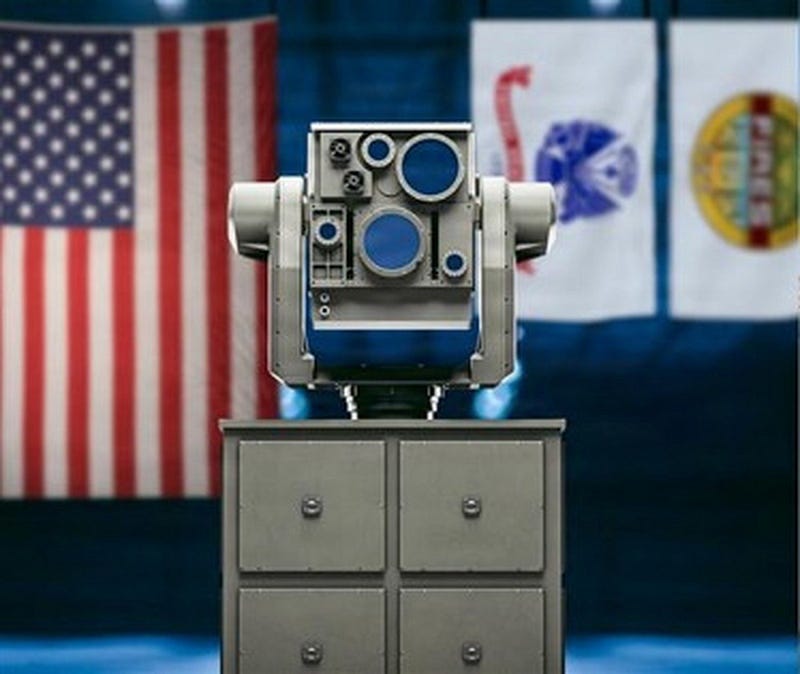
The U.S. Army’s Enduring-High Energy Laser system is designed to defeat unmanned aircraft at a lower cost per shot than conventional missiles. Photo by Darrell Ames/U.S. Army.
Originally published on Medium on September 5, 2026.
 Asia Horizon Review