By E.K KING
Russia Faced a 5.5 Trillion Ruble Cash Shortfall as War Spending Rose
Russia’s federal budget deficit approached 6 trillion rubles in the first four months of 2026. With military spending remaining high, Moscow is tightening spending elsewhere.
More than four years into the war in Ukraine, Russia’s military spending is putting growing pressure on government finances.
Finance Minister Anton Siluanov warned Prime Minister Mikhail Mishustin in April that the government might not have enough cash to make all scheduled payments on time, Bloomberg reported, citing people familiar with the matter.
At one point, the balance on Russia’s federal treasury single account showed a shortfall of roughly 5.5 trillion rubles, or about $65 billion.
That does not mean Russia was bankrupt. Moscow can still raise money through government bonds and other sources.
But the episode offered a rare glimpse into the financial pressure building behind Russia’s war effort. After more than four years of heavy military spending, the government is facing tougher choices over where its money goes.
A Deficit Approaching 6 Trillion Rubles
Official budget figures point to the same pressure.
Russia recorded a federal budget deficit of roughly 5.8 to 5.9 trillion rubles between January and April, equivalent to about 2.5% of GDP and nearly twice the level recorded during the same period a year earlier.
A budget deficit simply means the government is spending more than it receives in taxes and other revenue.
Military and security spending account for a large part of that burden.
Since the full-scale invasion of Ukraine began in 2022, Russia has poured money into its armed forces, weapons production, security agencies and industries supporting the war.
That spending helped Russia rapidly expand defense production and supported parts of the economy. It also created a system that requires Moscow to keep finding large amounts of money every year.
Military and security spending could exceed Russia’s existing budget plans by another 2 trillion to 4 trillion rubles this year, or roughly $23 billion to $47 billion, according to the Financial Times.
Borrowing Is Getting More Expensive
Russia still has the ability to borrow.
One of Moscow’s main options is issuing government bonds that can be bought by banks, financial institutions and other investors.
But borrowing carries its own cost.
Russia is now expected to spend roughly 4 trillion rubles a year servicing its debt, equivalent to around 9% of the federal budget.
That money does not buy new missiles, pay soldiers or build hospitals. It pays interest on money the government has already borrowed.
If Moscow relies more heavily on debt to cover future deficits, those costs could rise further.
The result is less room in the budget for everything else.
Spending Cuts Begin Elsewhere
So far, the Kremlin has shown little appetite for a major reduction in military spending.
Instead, the government has tightened control over other expenditures.
Following the cash pressure in April, non-military spending was cut by about 35%, while federal agencies are expected to reduce staffing by around 15%, according to Bloomberg.
Those figures are based on people familiar with the government’s decisions and have not been publicly confirmed by Russian authorities.
Siluanov has also presented a very different picture in public.
Just days before Bloomberg published its report, he told Russian state television that the budget had “no problems whatsoever” and was fully backed by available resources.
Kremlin spokesman Dmitry Peskov has previously acknowledged Russia’s budget deficit while describing the situation as manageable.
Publicly available information therefore does not independently confirm that Moscow came close to being unable to meet all its obligations in April.
The official deficit figures, however, do show a widening gap between government revenue and spending.
Russia Can Still Pay for the War
None of this means Russia is about to run out of money to fight.
Russia still has a large economy and several ways to finance government spending, including domestic borrowing, taxation, energy revenue and state-controlled financial resources.
That distinction matters.
After Russia invaded Ukraine in 2022, Western sanctions led to widespread predictions of a severe economic contraction. Moscow avoided the collapse some expected through capital controls, continued energy exports, heavy government spending and the rapid expansion of defense production.
For a time, military production itself became an important driver of economic growth.
Keeping that system running requires continued government spending.
As military expenditures remain high and debt-servicing costs increase, less money is available for other parts of the federal budget.
Moscow can borrow more, cut civilian programs or find additional sources of revenue. Each option allows the government to keep financing the war, but each also carries a cost.
Putin Keeps Military Spending a Priority
For now, Russia’s political leadership appears willing to accept those costs.
Finance Ministry and central bank officials warned President Vladimir Putin earlier this year that the current trajectory of war spending was becoming increasingly difficult to sustain, Bloomberg reported in June.
Putin has not responded with major cuts to military expenditure.
Instead, Moscow has looked for savings elsewhere while continuing to fund the armed forces and defense industry.
That means financial pressure alone is unlikely to force a rapid end to the war.
The next indicators will be Russia’s federal deficit, how much additional debt the government needs to issue, and how deeply Moscow cuts spending outside the military.
The 5.5 trillion ruble shortfall reported in April offers an unusual look at the strain inside Russia’s wartime finances.
Russia still has the resources to fund its military. But after more than four years of war, doing so is taking a growing share of what the government has available.
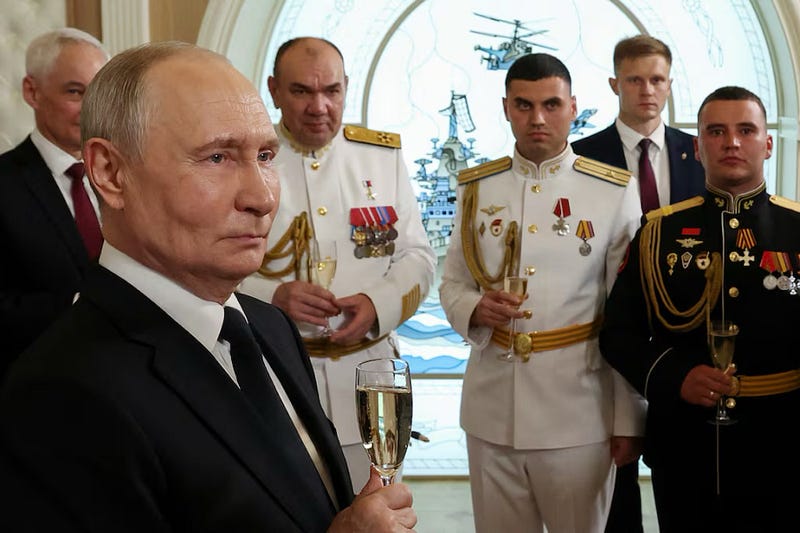
(AFP via Getty Images)
Originally published on Medium on August 31, 2026.
 Asia Horizon Review