By E.K KING
China has formally removed two of its most senior military leaders from their state posts, adding another chapter to a military shake-up that has reached deep into the top ranks of the People’s Liberation Army.
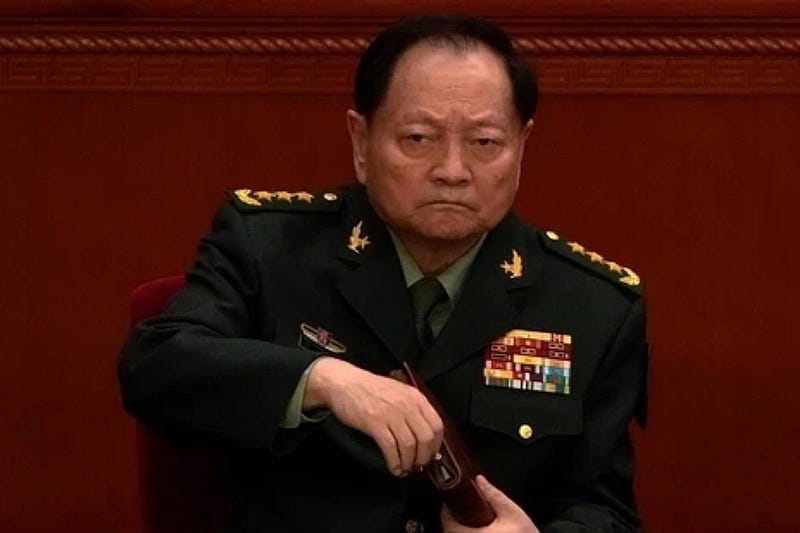
On August 28, the Standing Committee of China’s National People’s Congress removed Zhang Youxia from his position as vice chairman of the state Central Military Commission and Liu Zhenli from his position as a member of the commission.
The move was expected. Both men had already been placed under investigation in January for what Chinese authorities described as “serious violations of discipline and law.”
What makes the latest development important is not simply that two more Chinese generals have fallen.
It is where they sat in the military system.
Zhang was one of China’s most powerful military figures and served directly below Xi Jinping in the Central Military Commission. Liu headed the CMC Joint Staff Department, which plays a central role in military planning and coordinating operations across different branches of the PLA.
Their removal therefore raises a much larger question for China and its neighbors:
How much is the continuing purge affecting the PLA’s ability to plan and fight a modern war?
For Taiwan, Japan and the United States, the answer matters far beyond Chinese domestic politics.
The purge has reached the top
China’s military upheaval did not begin with Zhang and Liu.
Since 2023, senior officers linked to the Rocket Force, military procurement and other parts of the defense establishment have disappeared from their posts or come under investigation.
The purge later moved closer to the center of military power.
He Weidong, another CMC vice chairman, was among the senior figures removed in 2025. Then came the January 2026 investigations into Zhang and Liu.
Zhang’s case attracted particular attention because of his rank and background.
He was not only a CMC vice chairman but also a member of the Chinese Communist Party’s Politburo. He was also among the increasingly small number of senior PLA officers with actual combat experience.
Liu occupied a different but equally important position.
As chief of the Joint Staff Department, he sat close to the machinery responsible for turning political decisions into military plans.
That matters because modern warfare depends on much more than having missiles, ships and aircraft.
Those forces have to work together.
Taiwan is where that question becomes real
A major operation against Taiwan would be one of the most difficult military missions the PLA could attempt.
China would have to coordinate aircraft, warships, missiles, ground forces, intelligence, electronic warfare and logistics across the Taiwan Strait.
A blockade would already require complicated coordination. An amphibious invasion would be far more difficult.
This is one reason Beijing has spent years trying to improve the PLA’s ability to conduct joint operations – getting different branches of the military to fight as one force rather than as separate services.
Repeated turnover at the top creates an obvious problem.
New commanders need time to take over. Working relationships have to be rebuilt. Officers may become more cautious when they see senior commanders suddenly investigated or removed.
The Center for Strategic and International Studies has argued that the scale of the purges and the number of vacancies in senior positions could make it harder for the PLA to carry out large and complex military operations in the near term.
That does not mean the pressure around Taiwan is about to disappear.
China does not need to mobilize its entire military command structure every time it sends aircraft across the Taiwan Strait or warships around the island.
Coast guard operations, patrols, smaller exercises and other forms of pressure can continue even while the leadership is being reorganized.
For Taiwan, that creates an uncomfortable situation.
The PLA may face more difficulty carrying out an extremely complex war while remaining fully capable of maintaining military pressure below that level.
A weaker PLA is not necessarily a safer one
Japan and the United States face a similar problem when trying to read what is happening inside China’s military.
It would be tempting to look at the number of generals removed and conclude that the PLA has simply become weaker.
That would go too far.
China still possesses one of the world’s largest militaries. Its missiles, aircraft, warships and nuclear forces do not disappear when commanders are dismissed.
Beijing is also continuing to build new ships, expand its nuclear arsenal and invest heavily in missiles, drones and other military technologies.
What has become harder to judge is the human side of that military power.
How effectively can those forces be coordinated?
How much experience has been lost?
And how willing are officers to deliver bad news or question plans when senior commanders continue to fall?
Those questions matter in places where Chinese, American and Japanese forces operate close to one another.
A Taiwan crisis would almost certainly affect Japan because of geography and the presence of major U.S. military bases there. The East China Sea is already crowded with military aircraft and ships.
In such an environment, experienced commanders and clear communication can be just as important as weapons.
The danger is not limited to a planned war. An aircraft encounter, a collision at sea or a misunderstood military exercise can also create a crisis.
That makes uncertainty inside the PLA a security issue for the wider region.
The South China Sea is unlikely to become quiet
The same caution applies farther south.
China and the Philippines have repeatedly confronted each other in disputed waters, with coast guard vessels involved in collisions, water-cannon incidents and dangerous maneuvers.
Those operations are very different from launching a major war.
They can continue without the PLA mobilizing the full command system that would be required for a Taiwan conflict.
For Southeast Asian governments, the departure of two senior Chinese military leaders therefore offers little reason to expect immediate changes at sea.
What may matter more is who eventually replaces them.
The backgrounds of the next generation of senior commanders – whether they come from the navy, ground forces, aerospace forces or commands responsible for areas around Taiwan and the South China Sea – could offer clues about Beijing’s priorities.
China actually has two Central Military Commissions
There is also an important detail behind the August 28 announcement.
China has a Communist Party Central Military Commission and a state Central Military Commission.
The membership of the two bodies largely overlaps. In practice, they are often described in China as “one organization with two names.”
Zhang held the vice chairmanship in both structures. Liu was a member of both.
The National People’s Congress Standing Committee has now removed their positions in the state Central Military Commission.
As of August 28, Chinese authorities have not publicly announced their formal removal from their corresponding positions in the Communist Party’s Central Military Commission.
That distinction is unlikely to change their political future after they were placed under investigation, but it is important when describing what Beijing has formally done.
The next appointments may matter more than the removals
China is trying to do two difficult things at the same time.
It is building a military capable of fighting increasingly sophisticated wars while removing senior officers from the organization responsible for commanding that military.
In the short term, those purges may create gaps in experience and disrupt planning.
The longer-term outcome is less clear.
If Xi eventually fills those positions with a new generation of commanders who are politically trusted and able to rebuild the PLA’s command structure, today’s disruption may not last.
The result could eventually be a military with a very different senior leadership but many of the same – or greater – military capabilities.
That is why the most important question after Zhang Youxia and Liu Zhenli may no longer be what happens to them.
It is who comes next.
The officers chosen to fill the empty seats, the commands they come from and the experience they bring could tell Taiwan, Japan, the United States and other countries in the region much more about where China’s military is heading than another announcement about a fallen general.
Originally published on Medium on August 28, 2026.
 Asia Horizon Review