By E.K KING
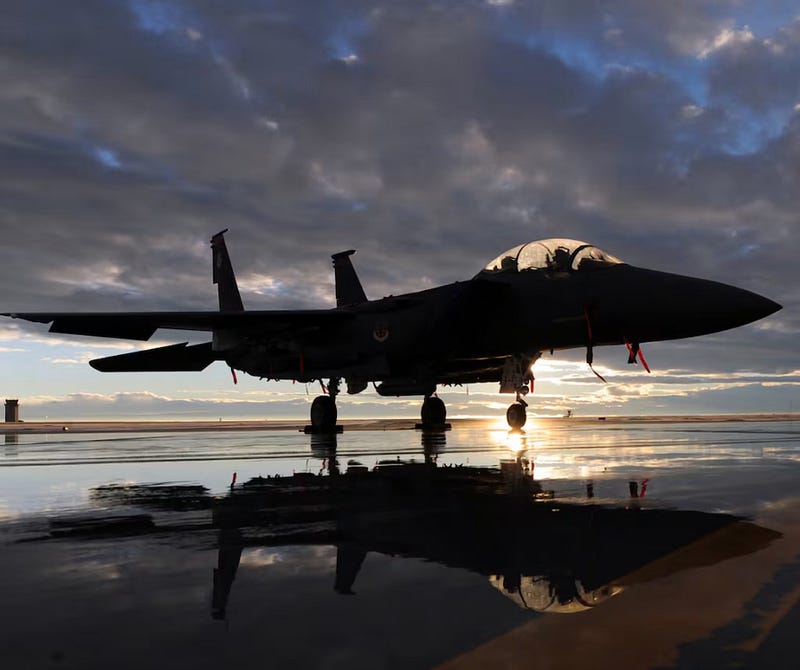
America’s next-generation fighter is already on the way, and F-35 production continues. Yet the U.S. Air Force is preparing to expand its planned F-15EX fleet from 98 aircraft to 268.
For a fighter whose lineage dates back to a first flight in 1972, that is an unusual turn.
The reason is not that the F-15 has suddenly become more advanced than the F-35. The Air Force is facing a much more immediate problem: older fighters are retiring faster than newer ones can replace them.
F-15C/Ds are already leaving service, while the long-serving F-15E fleet is also getting older. F-35 production continues, but the next generation of fighters will take years to arrive in meaningful numbers. The Air Force cannot afford to leave too large a gap in between.
The F-15EX can help fill it.
Although it is based on the F-15, the aircraft inside is very different from the Eagles that entered service decades ago. Its radar, avionics, mission computer and electronic warfare systems have all moved on.
There is also a practical advantage. The United States has operated F-15s for decades. Existing Eagle bases already have hangars, maintenance equipment, ground crews and years of experience supporting the aircraft.
Introducing an entirely different fighter can mean new infrastructure, equipment and training. Moving an existing F-15 unit to the F-15EX requires far less disruption and can put new aircraft into operational units more quickly.
But replacing aging aircraft alone does not explain why the planned fleet has grown all the way to 268.
The F-15EX also does a different job from the F-35.
One of the F-35’s biggest advantages is stealth. When a fighter has to operate against dense enemy radar and surface-to-air missile networks, reducing the chance of being detected can be critical. Its sensors and data systems can also find targets and share information with other forces.
The F-15EX does not have the F-35’s stealth.
What it does have is the ability to carry a lot of weapons.
Its large twin-engine airframe provides substantial payload and space, allowing it to carry large numbers of air-to-air and air-to-ground weapons, as well as some weapons that are simply too large for the internal bays of a stealth fighter.
Not every Air Force mission, however, requires a stealth aircraft.
Homeland defense, interception and patrol missions all require fighters. So do operations in airspace where friendly forces have already established air superiority. An F-35 does not have to perform every one of those missions.
That is why the expansion of the F-15EX fleet should not be read as the United States choosing the F-15 over the F-35.
The Air Force is still buying F-35s, and development of the next generation of combat aircraft is moving forward. It simply cannot wait for all of those aircraft to arrive before dealing with a fighter fleet that is aging today.
And now it appears the United States expects to need the F-15 for longer than many might have expected.
On Aug. 24, the Air Force awarded Boeing a long-term contract called F-15 Eagle Crest. It covers not only new aircraft production, but also upgrades, modifications, maintenance and sustainment for the broader F-15 fleet. Work could continue through 2037.
The contract has a ceiling of $131.23 billion.
That does not mean Washington has just spent $131.23 billion on F-15s, nor is it the price of the planned 268 F-15EXs.
No new fighters were ordered when the contract was awarded. Only $343,740 in fiscal 2026 research, development, test and evaluation funding was obligated at the time.
Eagle Crest instead gives the Air Force a framework it can use for years.
If the United States needs additional F-15EXs, upgrades for existing aircraft, spare parts or major maintenance work, orders can be placed under the contract over time. The initial ordering period runs through August 2031, with an option to extend it for another five years.
The deal also includes work to establish more heavy-maintenance capability inside the Air Force itself, allowing military depots to perform some major overhauls rather than depending entirely on Boeing.
That is not what a final round of support for a fighter nearing retirement looks like.
The United States is making sure that well into the 2030s, it can still buy F-15s, upgrade them and keep them flying.
And maintaining that system does not depend on U.S. orders alone.
Japan, Israel, Saudi Arabia, South Korea and Singapore already operate F-15 fleets. Those aircraft will continue to need parts, upgrades and maintenance, helping sustain the industrial base behind the fighter.
Eagle Crest also lists Indonesia and Poland among potential foreign military sales customers, even though neither country currently operates the F-15. Their inclusion does not mean either has decided to buy the aircraft, but it leaves a contractual path open for future business.
Israel is much further along.
An agreement reached in late 2025 covers 25 F-15IA fighters, with an option for another 25, at a reported value of about $8.58 billion.
The U.S. Air Force’s own F-15EX program report notes that the Israeli purchase helps stabilize lower-tier suppliers and extends the active life of the F-15EX production line.
That matters to the United States as well.
A fighter production line cannot simply be switched back on years after it closes. Engines, radars, electronics and airframe components come from many different suppliers. If orders disappear for too long, suppliers can leave the business and experienced workers can move elsewhere.
More F-15EXs for the United States, combined with foreign orders such as Israel’s, help keep that production network alive.
For Washington, that provides another form of insurance: if more F-15EXs are needed later, there will still be a factory capable of building them and suppliers capable of providing the parts.
Keeping the F-15 in Production Comes With Problems
Keeping the line alive does not mean Boeing can simply keep building the same F-15EX unchanged into the 2030s.
Aircraft can remain in service for decades. Electronic components often cannot remain in production nearly as long.
As the planned F-15EX fleet grows and production stretches further into the next decade, the Air Force is preparing to refresh several major systems. The radar, mission computer and electronic warfare suite are among them, while the engines are also part of the work ahead.
Production itself has faced problems.
A 15-week strike at Boeing’s St. Louis facility from August to November 2025 disrupted the program. Production recovery after the strike also fell short of planned targets, affecting the F-15EX’s previously scheduled July 2027 full operational capability milestone.
None of that has stopped the Air Force from expanding its F-15EX plans.
The reason comes back to the aging fleet it has to manage now.
F-35s are still arriving. The next generation of fighters will take time. Meanwhile, old F-15C/Ds are leaving service and parts of the F-15E fleet are moving closer to replacement.
The Air Force cannot wait until every next-generation aircraft is ready before filling the gaps appearing today.
The F-15EX does not have the stealth of the F-35, and its design lineage stretches back more than half a century. But the production line exists, current bases can support it, and pilots and maintainers already know the F-15. Its radar, computers, electronic warfare systems and weapons can continue to change.
The Eagle Crest contract now gives that approach another decade of room to run.
For a fighter that first flew in 1972 and was once expected to gradually give way to newer generations of aircraft, that may be the most important part of the $131.23 billion framework.
The arrival of the F-35 did not bring the F-15 story to an end. At least through the 2030s, the Eagle will remain part of the production, modernization and sustainment plans of the United States and several of its allies.
(U.S. Air Force)
Originally published on Medium on August 31, 2026.
 Asia Horizon Review