By E.K KING
A cheap attack drone is approaching. Shooting it down with an expensive air-defense missile works – but what happens when dozens of drones arrive at the same time?
That problem has become increasingly visible in Ukraine and the Middle East.
Japan is now looking at another option: using drones to shoot down other drones.
Japan’s Acquisition, Technology and Logistics Agency, or ATLA, has selected the Terra B1 interceptor drone developed by Japanese company Terra Drone for the Maritime Self-Defense Force. Defense News reported that Japan has signed a mass-production procurement agreement, although the number of drones and the value of the contract have not been disclosed.
The Terra B1 has a straightforward mission: intercept incoming drones before they reach their targets.
But the interceptor itself may not be the most interesting part of the story.
Terra Drone plans to use 3D printing to help manufacture the Terra B1, allowing parts of the system to be produced and modified more quickly. The company also wants to spread production across multiple locations instead of relying on a single large factory.
Japan is therefore experimenting with more than a new counter-drone weapon.
It is also testing a faster and more flexible way to build weapons for a type of warfare in which equipment can be consumed in large numbers.
Why Not Just Use Air-Defense Missiles?
The answer comes down partly to cost and supply.
One-way attack drones such as the Iranian-designed Shahed family have become a major feature of recent conflicts.
These weapons carry explosives toward a target and do not need to return. Their relatively simple design makes it possible to produce and launch them in large numbers.
Defenders still have to stop them.
Traditional surface-to-air missiles can do that, but repeatedly using expensive interceptors against cheaper drones creates a difficult equation.
The problem is not only money.
Air-defense missiles take time to manufacture, and stockpiles are limited. If an attacker can repeatedly send waves of relatively inexpensive drones, the defender may eventually face a shortage of interceptors even if its air-defense systems are performing well.
That has created growing interest in interceptor drones.
The basic idea is simple: detect an incoming drone, launch another drone to pursue it, and destroy the target before it reaches its destination.
These systems are not replacements for conventional air defense.
Fighter aircraft, cruise missiles, ballistic missiles and small drones present very different threats. Interceptor drones instead add another layer to the defensive network, particularly against slower targets that may appear in large numbers.
Japan Moved From Tender to Procurement in About Three Months
The speed of Japan’s program is another important part of the story.
The Defense Ministry launched an accelerated effort in 2026 to acquire interceptor drones capable of countering threats including one-way attack drones.
According to Terra Drone, 38 companies initially submitted proposals.
Four systems later entered testing by the Maritime Self-Defense Force between July 15 and Aug. 6. Terra B1 passed the demonstration phase and was subsequently selected by ATLA.
Janes reported on Aug. 26 that ATLA had selected Terra Drone to supply the Terra B1 to the Maritime Self-Defense Force. Defense News reported the following day that a mass-production procurement agreement had been signed.
The process took roughly three months.
Industry sources cited by Defense News said previous Japanese procurement competitions could take one to two years.
That difference matters because drone technology is changing unusually quickly.
A weapon that spends years moving through development and procurement could enter service in an environment very different from the one for which it was originally designed.
Electronic warfare changes. Sensors improve. Flight-control systems evolve. New countermeasures appear.
For counter-drone systems, the ability to adapt quickly may become almost as important as the performance of the original design.
From Ukraine to Japan
Although the Terra B1 is being developed for Japan, its story is closely connected to Ukraine.
Terra Drone expanded into Ukraine’s interceptor-drone sector in 2026, bringing Ukrainian companies Amazing Drones and WinnyLab into its group.
The company has described the Terra B1 as a Japan-made interceptor related to the Terra A1, a system that has already been deployed in Ukraine.
That connection is significant because Ukraine has become one of the world’s most intense testing grounds for drone warfare.
Designs are tested in combat, modified, produced and tested again. A successful system can quickly face new electronic warfare measures or changes in enemy tactics.
Japan is now trying to bring some of that rapid development cycle into its own defense industry.
There is, however, an important limitation.
Detailed performance figures for the Terra B1 remain scarce.
Janes has noted that although the B1 resembles the Terra A1, there are visible differences between the designs. Publicly released performance figures for the A1 therefore should not automatically be treated as specifications for the B1.
Japan has also not released detailed results from the recent trials.
For now, it is reasonable to say that the Terra B1 has passed Japan’s demonstration process and moved into procurement. It is too early to judge from public information how effectively it would perform against large drone attacks in actual combat.
Why 3D Printing Matters
The manufacturing method may be just as important as the interceptor.
3D printing is often discussed as a way to reduce manufacturing costs. For drones, however, another advantage may be more important: the ability to change designs quickly.
Traditional mass production can depend on specialized tooling, molds and established supply chains.
Changing a component can require changes elsewhere in the production process.
With additive manufacturing, some components can instead be produced directly from digital designs. Engineers can modify the design and manufacture a revised part without rebuilding every part of a traditional production line.
Terra Drone CEO Toru Tokushige told Defense News that 3D printing could simplify and shorten the design and prototyping process while allowing the company to move rapidly into mass production.
That flexibility matters in drone warfare.
A drone that works well today may encounter new jamming systems, sensors or interception methods several months later.
Manufacturers therefore face two requirements that can sometimes conflict: produce large numbers of weapons while continuing to modify them.
3D printing could make that balance easier for certain components.
What Happens If the Factory Is Attacked?
Terra Drone is also thinking about another lesson from Ukraine: the factory itself may become a target.
The company plans to distribute production across multiple locations and eventually expand manufacturing through local 3D-printing farms.
The logic is straightforward.
If production depends heavily on one large facility, a missile or drone attack against that facility could interrupt the entire supply chain.
Distributed manufacturing creates redundancy.
“Even if one production site were attacked by a system such as a Shahed-type drone, this distributed model could significantly reduce the risk of the entire supply chain being disrupted,” Tokushige told Defense News.
Ukraine has already demonstrated the usefulness of small-scale additive manufacturing during wartime.
3D-printing networks have been used to produce drone components, tools and other equipment needed by military units. They do not replace conventional defense factories, but they can make parts of the supply chain faster and more adaptable.
Japan appears increasingly interested in applying similar ideas to its own defense production.
The Bigger Story Is Not Just the Terra B1
There is still much we do not know about the Terra B1.
Japan has not disclosed how many interceptors it is buying or how much the contract is worth. Detailed flight characteristics and trial results also remain unavailable.
That means it would be premature to describe the Terra B1 as a proven answer to Shahed-type drone attacks.
But Japan’s decision is still important.
It brings together several ideas that have become increasingly visible in Ukraine: faster procurement, relatively inexpensive interceptors, rapid design changes, additive manufacturing and distributed production.
Together, they point toward a broader change in how countries may have to think about defense manufacturing.
Modern warfare is not only about building the most advanced weapon.
When drones and other systems are being consumed by the hundreds or thousands, another question becomes just as important:
Can you build weapons fast enough, in sufficient numbers, and replace them quickly enough after they are lost?
That may ultimately be the more important lesson behind Japan’s Terra B1 program.
On the surface, Japan is buying an interceptor drone.
Behind it, the country is experimenting with a different way of producing weapons for modern warfare.
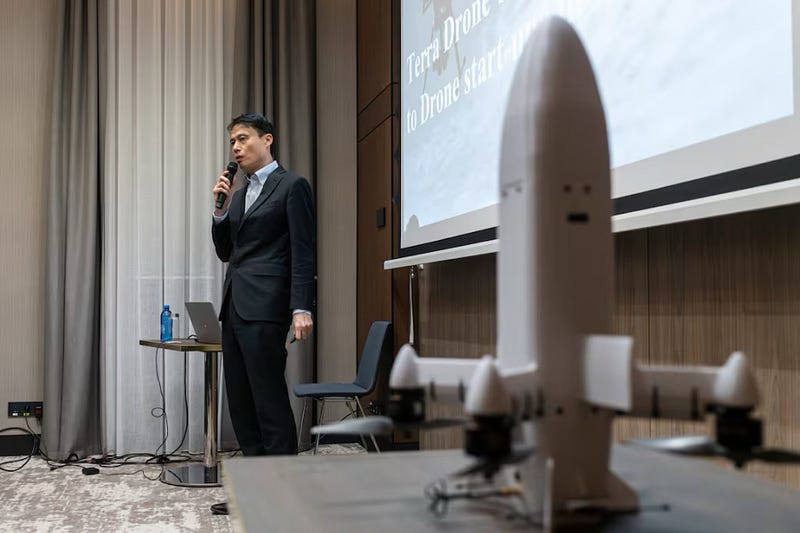
(Viktor Fridshon/Global Images Ukraine via Getty Images)
Originally published on Medium on August 28, 2026.
 Asia Horizon Review