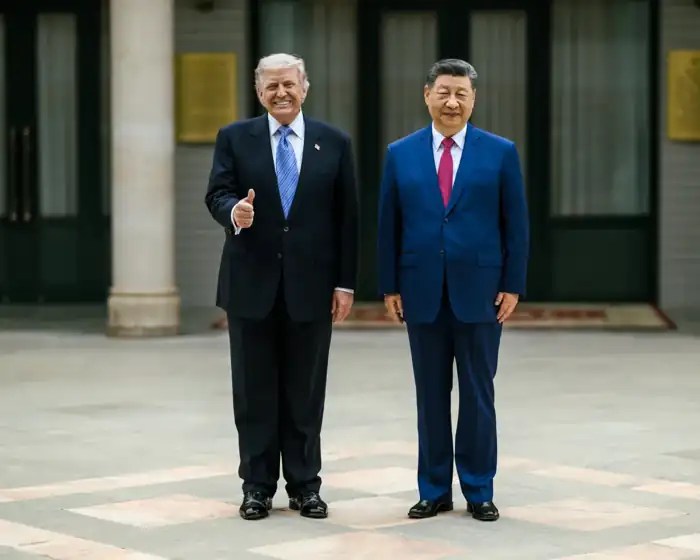
Donald Trump is preparing to meet Xi Jinping while a roughly $14 billion U.S. arms package for Taiwan remains under consideration. That timing puts Taiwan back into a familiar but uncomfortable position: central to U.S.-China competition, but not necessarily in the room when the two presidents decide what they want from each other.
The important question is not simply whether Taiwan will be mentioned. It is how far the discussion could go — from familiar statements about peace in the Taiwan Strait to questions involving arms sales, military activity and the broader U.S.-China relationship.
Taiwan is difficult to separate from the rest of the agenda
For Beijing, Taiwan remains one of the most sensitive issues in relations with Washington. China opposes U.S. arms sales to Taiwan and regularly argues that American military and political support encourages separatism. Washington, meanwhile, maintains unofficial relations with Taiwan and continues to provide defensive arms under U.S. law.
That makes Taiwan hard to isolate from any broader Trump-Xi discussion. Even if the meeting focuses on trade, technology or regional security, military activity around Taiwan and U.S. weapons support are likely to remain part of the strategic background.
The $14 billion question
The pending arms package matters because timing can become part of diplomacy. A major approval close to a presidential meeting could draw a strong response from Beijing. A delay, however, would also attract attention because it could raise questions about whether Taiwan policy is being affected by negotiations with China.
That does not mean the arms package will become a bargaining chip. There is no public evidence establishing such a trade. But the overlap in timing means decisions that might otherwise be treated as separate will inevitably be read together in Washington, Beijing and Taipei.
What could actually be discussed?
At the most basic level, both sides could restate long-standing positions. Beijing can press Washington to reduce military support for Taiwan, while the United States can emphasize stability and opposition to unilateral changes to the status quo.
The more consequential possibility would be discussion of practical restraint: military exercises, deployments, arms transfers or crisis communications. Any such discussion would matter because it could influence the operating environment around the Taiwan Strait even without producing a formal agreement.
There is also an important limit. A presidential conversation is not the same as a negotiated settlement, and public statements after a summit may reveal only part of what was discussed. Taiwan policy in Washington also involves Congress, the Pentagon and existing U.S. law, which constrains how much can be changed by a single meeting.
Taipei will be watching the wording
For Taiwan, small differences in language can matter. A reference to “peace and stability” is different from language suggesting new commitments or understandings. The timing of arms-sale decisions after the meeting may therefore be as important as the summit statement itself.
The Trump-Xi meeting is unlikely to settle the Taiwan question. What it can do is change the diplomatic environment around it. The clearest signals may come not from whether Taiwan appears in the official readout, but from what Washington and Beijing do in the days and weeks that follow.
 Asia Horizon Review