The United States may have entered recent fighting with roughly 414 SM-3 missile interceptors. Estimates suggest between 130 and 250 may…
By E.K KING
The United States may have entered recent fighting with roughly 414 SM-3 missile interceptors. Estimates suggest between 130 and 250 may have been fired during wartime operations.
If those estimates are close, the scale of the problem is easy to see: the U.S. can fire these missiles much faster than its factories can replace them.
The Pentagon is now trying to speed up that replacement process.
On Friday, it announced two seven-year framework agreements with Boeing and RTX aimed at expanding production of critical components for the Standard Missile-3, or SM-3, one of the U.S. Navy’s most important defenses against ballistic missiles.
No dollar value or production target was announced.
The length of the agreements may be more important. Boeing will be able to begin building some SM-3 components before individual contracts are completed, giving the company and its suppliers a clearer reason to invest in workers, equipment and additional factory capacity.
A missile that went from testing to combat
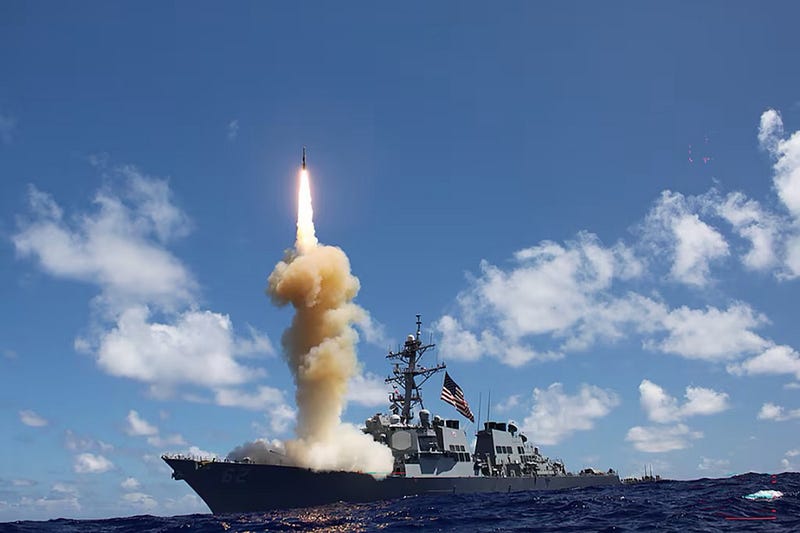
The SM-3 is carried aboard U.S. and allied warships equipped with the Aegis Ballistic Missile Defense system.
Its job is fairly simple to explain, even if the technology is extremely complex.
When a ballistic missile climbs high above Earth, an SM-3 can be launched from a ship to intercept it outside the atmosphere. The interceptor releases a small kill vehicle that tracks the target and destroys it by crashing directly into it at extremely high speed.
For years, most people knew the SM-3 through missile-defense tests.
That changed in April 2024.
U.S. Navy destroyers fired SM-3s in combat for the first time while helping defend Israel against a massive Iranian attack involving hundreds of drones and missiles.
Since then, SM-3s have been used in further combat operations, adding pressure to a stockpile that took years to build.
The Center for Strategic and International Studies estimated that the U.S. had about 414 SM-3 interceptors in its inventory as of December 2025. A later CSIS analysis estimated wartime expenditure at between 130 and 250 missiles.
Those figures are estimates rather than an official Pentagon inventory count, but they show why missile production has become such an urgent issue in Washington.
Even the lower estimate would represent a large number of expensive interceptors that eventually need to be replaced.
Why can’t the U.S. simply order more?
Building an SM-3 involves a network of specialized companies.
Raytheon, an RTX business, is the prime contractor. Boeing supplies important parts including avionics and ejector assemblies for the SM-3 Block IB and the newer Block IIA.
Increasing production therefore requires more than asking the final assembly line to work faster.
Companies farther down the supply chain need to increase their own production. They may need new machinery, additional workers and larger supplies of specialized materials.
That becomes difficult when a supplier does not know how many components the Pentagon will buy several years from now.
The new seven-year framework gives industry a much longer view of expected demand.
Boeing can start work on components while the Pentagon, Boeing and RTX negotiate a multiyear agreement. For suppliers considering whether to spend money on expanding a factory, that extra certainty matters.
Washington has already tried a similar approach elsewhere. In April, Boeing reached a seven-year agreement connected to increasing production of seekers for the PAC-3 Missile Segment Enhancement interceptor.
The Pentagon is applying the same idea to another missile that has seen heavy demand.
The older SM-3 is staying alive
The agreements cover two versions of the interceptor: the SM-3 Block IB and Block IIA.
The Block IIA is larger and more capable. It was jointly developed by the United States and Japan and is an important part of missile defense for both countries.
Earlier this month, the Missile Defense Agency awarded Raytheon a $745 million contract for fully assembled Block IIA interceptors for the United States and Japan.
The future of the older Block IB had been less certain.
The Missile Defense Agency previously proposed ending new purchases of the Block IB in its fiscal 2025 budget request. Congress stepped in to keep production going.
That decision looks more important after several years of missile combat.
Keeping both versions in production gives the U.S. another way to rebuild its interceptor inventory instead of depending entirely on the newer Block IIA production line.
This also matters in Asia
Japan has a particularly close connection to the SM-3.
Tokyo helped develop the Block IIA with Washington, and Japanese Aegis destroyers are part of the country’s ballistic missile defense network.
The same production lines supporting U.S. forces therefore also affect an important American ally in the western Pacific.
There is a larger concern as well.
China has built a large force of ballistic missiles capable of striking military bases, ports and other targets across the region. A major conflict in the western Pacific could create intense demand for missile-defense interceptors within days.
Recent combat in the Middle East offers a useful warning about what that could mean.
A navy can spend decades developing an interceptor and years building its stockpile. During a large missile attack, dozens can be fired in a very short period.
Replacing them happens at factory speed.
That is the problem behind Friday’s seven-year agreements.
The SM-3 has already proved that it can be used in real combat. The Pentagon now has to make sure the production system can keep up with how quickly modern wars consume missiles.
(U.S. Navy)
Originally published on Medium on August 15, 2026.
 Asia Horizon Review