By E.K KING
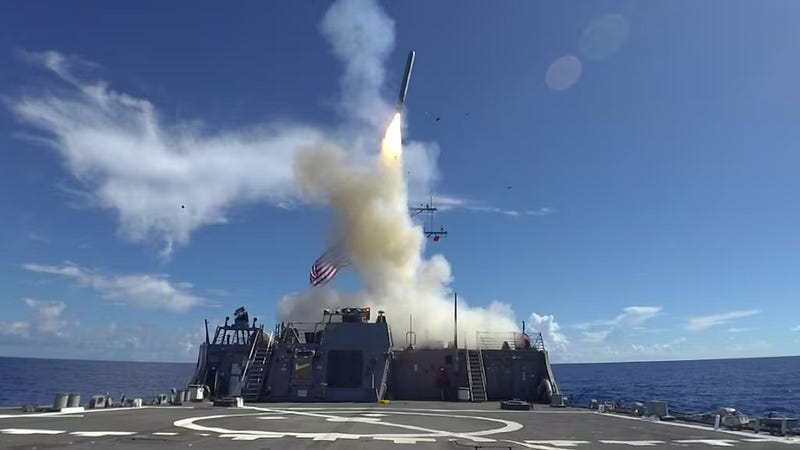
(MC2 Taylor DiMartino/U.S. Navy)
What if a long-range precision strike weapon cost a fraction of a Tomahawk missile?
That is the question driving the U.S. Department of Defense’s latest initiative. Facing dwindling stocks of expensive precision-guided munitions after recent military operations, the Pentagon is seeking a new generation of low-cost, long-range autonomous strike systems that can be produced rapidly and in large numbers.
Known as Ground-Based Affordable Mass (GBAM), the initiative reflects a broader shift in modern warfare: success may depend not only on possessing the most advanced weapons, but also on having enough of them when conflicts become prolonged.
Lessons from Recent Conflicts
Recent wars have demonstrated that even technologically superior militaries face challenges when high-end precision weapons are consumed faster than they can be replaced.
Cruise missiles such as the Tomahawk provide exceptional long-range precision, but they also carry significant costs and require lengthy production timelines. In an extended conflict, relying solely on premium weapons can strain inventories and reduce operational flexibility.
The Pentagon’s answer is not to replace these sophisticated missiles, but to complement them with affordable alternatives that can perform many strike missions while reserving high-end munitions for the most demanding targets.
What Is GBAM?
The Defense Innovation Unit (DIU) has launched the GBAM Challenge, inviting industry to propose mature systems capable of moving from demonstration to production at unprecedented speed.
The requirements are ambitious:
- Ground-launched strike system
- * Minimum range of 600 nautical miles (approximately 1,110 km)
- * Payload between 35 and 100 pounds
- * Autonomous target recognition and terminal guidance
- * Ability to operate in GPS-denied and electronic warfare environments
- * No proprietary launch equipment required
- * Low-signature, rapidly deployable launch methods preferred
Interestingly, the Pentagon has not specified whether GBAM should be a missile, a loitering munition, or another form of autonomous strike platform. Instead, it focuses on the operational effects the weapon must deliver.
Speed Is the Priority
Perhaps the most remarkable aspect of the program is its timeline.
Companies must submit proposals by August 5, with selected teams invited to conduct flight demonstrations at a government test site as early as November – roughly three months after the challenge was announced.
The Pentagon ultimately wants systems that can transition into production within 12 to 18 months, an unusually aggressive schedule for a new defense capability.
Winning teams will receive cash awards and may qualify for prototype contracts, operational testing opportunities, and follow-on production agreements. The U.S. government has allocated up to US$250 million to support the initiative and future transition efforts.
Affordable Mass Is Becoming a Strategic Priority
GBAM is not an isolated project.
It is part of a growing Pentagon strategy known as Affordable Mass – developing large numbers of lower-cost autonomous systems that can supplement traditional high-end weapons.
Other efforts include affordable cruise missile programs and containerized launch concepts designed to increase production capacity while reducing overall cost per strike.
The underlying logic is straightforward: in future conflicts, industrial capacity may prove just as important as technological sophistication.
Why This Matters Beyond the United States
Although GBAM is an American initiative, its implications extend well beyond U.S. defense planning.
Across the Indo-Pacific, governments are investing heavily in unmanned systems, autonomous technologies, and long-range precision capabilities. If the United States successfully demonstrates that effective strike weapons can be produced at dramatically lower cost and at much greater scale, similar approaches may influence defense planning throughout the region.
This could accelerate competition in autonomous military technologies while reshaping how countries think about deterrence and force structure.
The Bigger Picture
The Pentagon’s GBAM initiative highlights a significant evolution in military thinking. Future wars may no longer be determined solely by the quality of individual weapons, but by the ability to sustain operations through rapid production and affordable systems deployed at scale.
Yet this trend also raises broader questions. As autonomous weapons become cheaper and more accessible, the threshold for prolonged conflict could become lower. Technology may reduce the financial cost of warfare without reducing its human consequences.
Innovation undoubtedly strengthens national defense. At the same time, lasting security ultimately depends not on producing more weapons, but on preventing conflicts from escalating into wars that require them.
⸻
Originally published on Medium on July 28, 2026.
 Asia Horizon Review